Sunday, December 4, 2011

THE NUTCRACKER by Warren Chappell

The Nutcracker has been adapted for picture books many, many times. Some based on Hoffman's original story, some the ballet.

One that stood out to me even as a child was an adaptation by Warren Chappell. This was first published in 1958. It's a rectangular volume, wider than it is high, in a green cover with silver stamping. The dustjacket tells the Nutcracker nut that this isn't going to pretend to be the original. It tells you it's adapted from Dumas' adaptation of Hoffman right off!

Chappell's adaptation is a very faithful adaptation. It feels more like an abridgement than an adaptation though it isn't. It makes for a lively retelling.
However, the big features of the book are still to be explained. First, there are the wonderful illustrations by Chappell. His line art and color pages bring the story whimsically and beautifully to life. Even his seven-headed Mouse King is well-done, though he is so massive, one wonders how he's even a threat.

But that's not all! Actual sheet music for Tchaikovsky's score appear on the pages, illustrated. When I was a kid and got the book from the library, I recall asking a music teacher at school to play from it. (She did.)

Quite an excellent book. Not only is it a good adaptation, it's also a really attractive little book.


Saturday, December 3, 2011

The Nutcracker Ballet

"[Music] reveals an unknown kingdom to mankind: a world that has nothing in common with the outward, material world that surrounds it, and in which we leave behind all predetermined conceptual feelings in order to give ourselves up to the inexpressible." — E.T.A. Hoffman
 And now it's impossible to talk about the legacy that Hoffman's Nutcracker has had without mentioning Pyotr Ilyich Tchaikovsky's ballet version. When you mention the Nutcracker story, this is what people think of first usually. (Unless they're crazy Hoffman nuts like me.)

Photo of the original 1892 production
The most famous bit of the ballet is Tchaikovsky's score. When the ballet bombed at first, a 20-minute suite kept the music alive until the ballet was revived, becoming annual traditions all over the world.

The Nutcracker ballet was originally in a double bill with Iolanta. Marius Petipa adapted Dumas' rewriting of the book for the ballet and also was the original choreographer. Tchaikovsky wrote the score to accompany it. It was not one of his fondest works.

The original production was staged in 1892, a week before Christmas. From what I can tell, the basic plot of the ballet as it is normally done was there, dictated by the names of the pieces of score. The children eagerly await the Christmas party, where gifts from Drosselmeyer and arrivals of many guests are the highlights. Clockwork people by Drosselmeyer and the Nutcracker are major points. Music highlights the cracking of nuts before a hostile Fritz breaks the Nutcracker. The girl, who was renamed Clara in the ballet, takes care of the Nutcracker and returns to the drawing room to see him at night.

Photo of the original 1892 production
Magic happens when it gets late as Drosselmeyer appears on the clock, and to accommodate the plot, Clara grows smaller, shown by the Christmas tree growing to an immense height. Mice and toys begin to fight, the Nutcracker leading the toys. The King of Mice (who, depending on what is possible for the producers, may have seven heads or just one highlighted by a crown or sash or something else) fights the Nutcracker, and almost overpowers him, but Clara throws her shoe at the King, and, depending on what the choreographer has decided, it inexplicably kills him, or allows the Nutcracker to turn the tables, killing the King of Mice.

Set design from the original 1892 production
In a wooded scene, the Nutcracker turns into a prince and he and Clara go to a land of sweets where the Nutcracker Prince recounts his story and then dancers depicting various sweets or drinks or spices dance for the Nutcracker Prince and Clara, usually climaxing with the hostess, the Sugar Plum Fairy, dancing with either her Cavalier or the Nutcracker. (In some productions, Clara takes the place of the Sugar Plum Fairy, sometimes even becoming that character.) In the ending, the Nutcracker Prince and Clara leave to continue their journey or to go home, or Clara awakes and the ending is left ambiguous as to whether it was a dream or not.

Set design from the original 1892 production
There have, of course, been many variations of the ballet over the past 119 years. Some keep to this basic format, like George Balanchine's famous versions. Others try to reimagine the story for various reasons. As the format of ballet doesn't allow for much exposition, these are more or less forced to portray what they can on stage. The story of Princess Pirlipat is almost impossible to tell in the ballet, though the Pacific Northwest Ballet attempted to do a pantomime version in the party with music not from the original suite.

Mother Ginger and her children, 1892 designs
Other versions have the story become a metaphor for Marie (or Clara, productions change the name as they want) going from a young girl to a young woman, to some very sensual interpretations. Matthew Bourne's Nutcracker's second act features the heroine trying to get the Nutcracker back from her fairyland romantic rival!

But when the story gets down to basics, it's a reasonably faithful adaptation of the story. Yes, there's a big jump from the battle to the defeat of the Mouse King, but given the storytelling limits of ballet, it works. And the music is just beautiful. It really captures the story and fits it perfectly. More information about variations on the ballet may be found here.

Original 1892 costume design
The ballet has become a holiday staple for ballet companies, all with some variants on the story and huge differences in choreography. Many large companies even have their productions professionally filmed and released on home video, television, or even films. I had two of the latter on video tape: George Balanchine's The Nutcracker featuring Macaulay Culkin as the Nutcracker Prince, and The Nutcracker: The Motion Picture by the Pacific Northwest Ballet, featuring set designs by artist Maurice Sendak. (These designs were retooled as illustrations for Ralph Manheim's translation of the original Hoffman book.)

So, as it might be tempting to dismiss the ballet as an overly popular rival to Hoffman's original story, it's a wonderful holiday tradition well worth preserving.

Friday, December 2, 2011

Histoire d'un casse-noisette

I was surprised to find that Alexandre Dumas had rewritten Hoffman's story. I mean, he's the guy who wrote The Three Musketeers, The Man in the Iron Mask, and The Counte of Monte Cristo. Histoire d'un casse-noisette (translated The Story of the Nutcracker) was published in French in 1844. I can only imagine this was done because there had been no French translation of the German story.


The famous Nutcracker ballet actually used Dumas' text over Hoffman's, as it was in French, and the writer of the original libretto was the French choreographer Victor Marius Alphonse Petipa. In English, however, a translation of Dumas' retelling is harder to find than Hoffman's. I found a digital version of the book on Internet Archive, a French 1921 edition with the 1846 illustrations by Bertall (Charles Albert d'Arnoux). Finally, I discovered that Penguin books had published it in tandem with a translation of the original Hoffman.

Dumas' adaptation, retelling, revision, translation, what have you, opens with him telling how he was asked for a tale by children. The only "tale" he can think of is Hoffman's The Tale of the Nutcracker. Yes, he credits Hoffman openly, so no foul on him.


Dumas' narrative flows very much like Hoffman's original, beat for beat. However, while Hoffman opened the story describing the children's POV of their parent's Christmas Eve preparations, Dumas introduces the place, characters, and even describes the differences between German and French Christmas customs for families. Also, Hoffman's Stahlbaum family becomes Dumas' Silberhaus family. No mention is made of older sister Louise.


In addition, the rivalry between the Nutcracker and Mouse King is clarified earlier on. The Nutcracker taunts the Mouse King, asking if he's come to accept the challenge that had been laid down. The Mouse King says he's avenging his mother.

The tale of Princess Pirlipat is told in a single, long session, and instead of fat, this particular translation of Dumas describes bacon as being used in the sausages the queen makes that Madame Mouserinks wants to eat. Though bacon has a fat in it, I can hardly imagine it would serve the correct purpose in sausage making as fits the story. (The lack of fat making the sausages dry and coarse.) Upon checking, the word "fat" appears to be what Dumas intended. The travels of the clockmaker are expanded upon briefly as well, and Dumas notes that the expression "That's a hard nut to crack" (which seems to be obscure now), stems from Pirlipat's story.


Dumas adds other little details here and there, such as Drosselmeyer's nephew being named Nathaniel, and the Mouse King being a bit sillier in his threats, but still, he doesn't really deviate from Hoffman's story.


Overall, over the two, I prefer the original Hoffman. While Dumas did a fine job of making sure the story would be understood well, his over-explanation and attempt to streamline the story takes away the dreamy qualities of Hoffman's fantasy.


The Penguin translation I mentioned doesn't do Dumas (or Hoffman) any favors, only giving us a bare translation that is not enjoyable to read.

For an example of Dumas' additional details, here's the paragraph analogous to the one I posted in yesterday's blog.
After one year, the fiance came back for his wife in a little carriage of mother of pearl inlaid with gold and silver, drawn by horses that were not bigger than sheep, and a priceless worth, they had not seen their like in the world, and it took them to the palace of Marzipan, where they were married by the chaplain of the castle, and or twenty-two thousand little figures, all covered with beads, dazzling diamonds and jewels, danced at their wedding. So that at the present moment, Marie is still queen of the beautiful kingdom where you can see all the bright forests of Christmas, and rivers of orangeade, almond and rose essence and palaces of translucent sugar finer than snow and clearer than ice, and finally, all manner of things wonderful and miraculous, provided you have quite good eyes to see them.
And now I leave you with more of Bertall's illustrations. 

Thursday, December 1, 2011

The Nutcracker and the King of Mice

E.T.A. Hoffman's The Nutcracker and the King of Mice was written in 1816. Given the legacy it has had, it is hard for us to realize the story was written as a dark fantasy.

The young Stahlbaum children, seven year old Marie and her older brother Fritz, eagerly await their Christmas presents from their parents and godfather Drosselmeyer, although they usually only enjoy their godfather's clockwork gifts for a brief time before they are put away. Fritz grows tired of a clockwork castle Drosselmeyer has created, preferring his toy army. Marie is quieter and more appreciative. She finds a wooden nutcracker soldier. The family enjoys cracking nuts until Fritz uses the biggest and hardest nuts that break off some of the Nutcracker's teeth and ruins his jaw.

The Nutcracker is left in Marie's care and she is allowed to stay up a little late to ensure the Nutcracker is seen to. When she begins to head to bed, she sees the owl on top of the clock has turned into Drosselmeyer. Mice swarm into the room, and Marie crashes into the glass toy cabinet. The toys in the cabinet come to life, Fritz's soldiers being led by the Nutcracker to battle against the mice and their seven-headed king.

It appears the toys are winning, but the mice keep coming, and the Mouse King is fighting with the Nutcracker one on one. Marie takes her slipper off and throws it at the Mouse King, but as she does, she goes unconscious.

The next morning she awakes in her bed, bandaged, with orders to stay in bed (with medicine the way it was in those days, a cut would need to be observed over time for infection). Fritz and Drosselmeyer visit after Marie is well enough to sit up in bed for a time. Drosselmeyer has repaired the Nutcracker, and Marie demands to know why he didn't help the Nutcracker. Drosselmeyer says a mysterious rhyme and then proceeds to tell her the Nutcracker's story, which is broken into three parts that he tells over three days.

In an unnamed kingdom, a king and queen had a daughter named Pirlipat, who was hailed as the prettiest baby. But she was always kept guarded. Before her birth, the queen was making her special sausages for a special banquet, but as she was doing so, Madame Mouserinks, queen of the mice, appeared and demanded some of the fat. The queen offered her some, but other mice came and ate almost all of the fat, leaving very little for the queen to make her sausages with, making them too dry and coarse. The king expressed his outrage by having a clockmaker create mouse traps to rid the castle of mice. The clockmaker did his job well, killing every mouse except Madame Mouserinks.

Madame swore to get even with them by cursing their new baby. Despite a watch of six maids with six cats, Madame made good on her vow and cursed the princess, making her hideously ugly. The clockmaker and court astronomer are called to find a cure for her (which involves a scene where we're told they examined her by taking her apart, rather disturbing), and they discover that if a young man who has never shaved or worn boots breaks the krakatook nut with his teeth and feeds it to Pirlipat, she will be restored. However, the krakatook nut is the rarest nut in the world and they spend fifteen years looking for it and a man who fits the description.

Homesick, the clockmaker wishes to visit his brother in Nuremberg. When he tells his brother of his troubles, the brother laughs, because not only does he have a krakatook nut, his son fits the requirements to crack it and give it to the princess! They hurry to the castle, where the young man cracks the nut with his eyes closed and takes seven steps backwards, breaking the curse. On the seventh step, he steps on Madame Mouserinks. With her dying breath, she turns him into a nutcracker, saying that her seven headed son (disturbingly created from her seven dead sons) will defeat the Nutcracker, who can only be restored if he wins unconditional love of a young woman.

Marie realizes her Nutcracker must be the clockmaker's nephew, and the clockmaker himself is none other than Drosselmeyer. That night, the Mouse King arrives and threatens to chew the Nutcracker into splinters if she doesn't give him some of her things. She agrees, but when he begins to repeat his demands, she worries she will have nothing left soon. When she tells the Nutcracker this, he comes to life and tells her he needs a new sword so he can defeat the Nutcracker. When she explains this to Fritz, he happily provides a sword for the Nutcracker. (This redeems Fritz for his poor treatment of the Nutcracker earlier.)

That night, the Nutcracker fells the Mouse King in combat, and takes Marie through her father's coat to a ship and they sail to a land made of candy, where all the things Marie sacrificed are now immortalized as actual characters. She looks into the water while sailing to his castle and sees a beautiful princess that she thinks must be Pirlipat. Nutcracker assures her that it couldn't be Pirlipat. A princess who would shun a young man who had sacrificed so much for her couldn't be that pretty. The beautiful princess is Marie herself.

At his castle, Nutcracker is greeted by his sisters, who are crying for joy at his return. Nutcracker and Marie are entertained by people preparing food, and Marie is even asked to grind rock candy. Marie finds herself being lifted away dreamily, and finally awakens in her own bed. Her parents don't believe her tale of the Nutcracker. When she shows them the Mouse King's crowns the Nutcracker gave her, her father says they're from his old watch. She is forbidden to speak of her experiences again.

When Marie has grown older, she finally declares her love for the Nutcracker. Drosselmeyer overhears and dismisses it as nonsense. Marie faints, but when she awakens, she discovers they have a guest: Drosselmeyer's nephew from Nuremberg. After charming the family with his manners and nut-cracking, he assures Marie he returns her love, and we are told they are married afterward and go to live in his kingdom.

Despite how it was supposed to be a dark fantasy in 1816, today, the story reads beautifully and charmingly. I loved it as a kid. I have two versions of the book: Ralph Mannheim's translation (I did say it's a German story, right?) illustrated by Maurice Sendak, and a "retelling" that was little more than a slightly abridged translation by Warren Chappel. Both of them manage to be more than flat translations, infusing the story with an actually fun writing style. However, some satire got lost in translation, which made the story better. Here's the end of the story, roughly translated by Google and myself:
After a year he had them, as they say, picked up in a golden carriage drawn by silver horses. At the wedding were twenty-two thousand of the most brilliant dancing figures ornamented with pearls and diamonds. And Marie will still be forever the Queen of the country where there are everywhere shiny Christmas forests, transparent marzipan castles, and you can behold the most glorious wonderful things, if you only have eyes to afterward.
 Yeah... It gives you the impression that a land of Christmas trees and candy castles might get disgusting. (As a jaded adult, I agree.) Here's how Ralph Manheim translated it:
In a year and a day he called for her in a golden carriage drawn by silver horses. At the wedding, two and twenty thousand of the most brilliant figures adorned with pearls and diamonds danced, and Marie is believed to be still the queen of a country where sparkling Christmas woods, transparent marzipan castles, in short, the most wonderful things, can be seen if you have the right sort of eyes for it.
See the more gentle phrasing?

Whatever the phrasing, it's still a wonderful story about love and the fascination children can have with Christmas and make believe. Hoffman writes in a dreamy fashion, never telling you that Marie's visions of the Nutcracker are true or not until the very end. He manages to perfectly capture the excitement of the children for their Christmas presents, and his characterization of Fritz is an oft-ignored gem. Drosselmeyer's mysterious manner can be charming or downright creepy when needed. Marie's wide-eyed innocence and childish faith in her amazing visions of the Nutcracker and his kingdom are convincing.

And the Nutcracker story has proved to be quite inspirational.

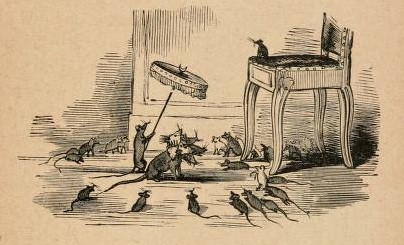
(The images are illustrations by Artuš Scheiner from an edition published in Prague in 1924. It seems they were scanned by josefskrhola on Flickr.)

Wednesday, November 30, 2011

Announcing ... The Nutcracker

Starting tomorrow will be a look at 18 different versions of The Nutcracker, starting with the original books and the ballet, then different screen and even audio adaptations. One blog a day.

I decided against doing different blogs about different variations of the ballet. For those that want more information, the blog about the ballet has a link to a very informative page about variations.

The blogs will conclude on December 19th with a personal reflection by myself.

Saturday, September 3, 2011

How to make it big in the UK

1. Learn to act
2. Learn to sing
3. Learn to dance
4. Have good presence and a pleasant disposition
5. Appear on Doctor Who or another highly rated UK TV show
6. Create humorous viral videos
7. Pitch a TV show
8. If the pitch doesn't work, redevelop and try again
9. Twitter doesn't hurt
10. Don't take this list seriously

Wednesday, January 19, 2011

Being Human US and Being Human

Imagine this opening, a young man walks into the woods, and mysteriously begins to undress, then covers his genitals with his hands and waits. As the full moon rises, he has spasms of pain and begins screaming. Suddenly, he begins to transform, growing claws and his face expanding into a snout. He's a werewolf.

Meanwhile, another young man is talking with a beautiful young woman. She lets him seduce her and welcomes him to casual sex. And through this, his eyes suddenly turn black, though she doesn't see that, and as they become intimate, he bites her neck with fangs that have suddenly appeared. He's a vampire.

So, that is how Being Human opens. But which version, the original BBC production that began with a pilot in 2008, or the just premiered new series on SyFy? The answer: both.

So, yes, I am a fan of the original BBC Being Human, so that really tainted my view of the SyFy remake. As someone in a review I read pointed out, remaking British shows like The Office and Skins (neither of which I've really watched either version of) is understandable, because while the humor may be global, the cultural difference can be keenly felt in places like jobs and schools. Being Human, on the other hand, is a supernatural show, and aside from accents and Annie's fondness for tea, there is little that is exclusively British. Yes, it was Being Human that sent me into my descent to Anglophilia.

I suppose the "little that is exclusively British" would also be an argument for remaking it as an American series. The big problem a lot of people really worried about was that the original series would use the supernatural to examine the human condition and unfortunately, a lot of American series are not known for being deep, but just really developed stories. (Or barely developed.) Every now and then, something really good comes along, but it eventually degrades. (And don't think that I think only American series degrade in quality. It's happened in the UK.) Has the time of great American TV programming passed? Well, you can barely try to use a remake of a British series to win that argument...

So, I did watch the first episode of SyFy's Being Human. Twice, in fact, as it was available on SyFy's On Demand channel through my cable provider. My thoughts?

First off, I was very disappointed that the story of the first episode was very much modeled on the original's withdrawn pilot and first episode. (Withdrawn? Yeah, the original recast from pilot to series, whatever, back to SyFy's show.) My enjoyment of the show would largely be based on what was new and fresh.

So, what did I get in that area in the first episode? Extremely little. As I already pointed out, the pre-titles opening of the episode mirrors that of the original's pilot.

Josh is a werewolf, Aidan is a vampire. They both work at a hospital and get a house together, only to discover it is haunted by Sally, a young woman who recently died in the house (her ex-fiancee Danny is the landlord), though she can't remember how. Josh discovers his sister, Emily, is visiting her girlfriend at his hospital, and the two meet, Josh having left his family behind after becoming a werewolf. Meanwhile, Aidan is dealing with with his accidental killing of Becca, the girl he bit in the opening. Bishop, an older vampire who works as a police officer, is pushing Aidan to come back to the other vampires. At the end of the episode, Josh is transforming locked in a room in the hospital basement, desperate for someone to get Emily out of there.

There are some changes in mythology for ghosts and vampires. Sally, unlike the original's Annie, is completely intangible and is confined to the inside of the house. (At least, for now. I'm expecting that this may change.) In the original, Mitchell the vampire curbed his bloodlust with food, claiming carbs had become his blood substitute. Aidan cannot eat normal food. (Great, Josh will have dinner with his two roommates just watching him.) And while not a change in mythology, the vampires appear to use "blood whores," women (or other vampires?) who bleed themselves willingly for vampires to feed from. This wasn't exactly present in the original, though the second series did have an emo girl visit the vampire headquarters expecting to be fed from.

Just about the only other changes I noted was that the original's pilot didn't have George the werewolf's sister, but his ex-fiancee, who was admitted into the hospital where he worked. In addition, the pilot didn't end with that cliffhanger. Annie managed to rescue George's ex before anything could happen to her. I am also unsure as to whether or not Aidan has sworn off blood. They might be having him come to the decision.

Now, a critical factor in the original was that the main cast gelled. Even in the original pilot, the cast had chemistry before two thirds of them were recast. And then it worked again after the recasting. Here, Aidan and Josh do act off each other very well, but both seem very distant from Sally, thus making her the character I sympathized with the most. However, if the ensemble cast is going to work, this really needs to change. (I understand from a press review that it is still felt in the third episode.) In the original, George grudgingly put up with Annie's presence, while Mitchell whimsically entertained it, before Annie managed to endear herself to George.

Josh feels a lot like a lighter version of George, not quite as neurotic or even as funny, but then Russell Tovey is a hard act to follow. Aidan, on the other hand, doesn't strike me as quite genuine. He's supposedly 200 years old, or so I understand from press releases, but why is he so weepy and upset when he accidentally kills Becca in the opening? You'd think that after two centuries of drinking blood, if he was going to reform and slipped, he'd be disappointed, but not crying over it. And he doesn't strike me as mature enough for 200. It's not just the actor's look, it's the way the character is being portrayed. I've never seen most of the cast in anything before (Sam Huntington, Josh, I did see briefly in Superman Returns as my favorite supporting character Jimmy Olsen), so I'm hesitant to write them off as bad actors. It can be entirely in how they were directed to act, or how the part was written.

Is SyFy's Being Human different from the original? Yeah, but the differences in plot aren't too big. The other differences aren't building any confidence. Now, yes, the show has just started, so I've decided to try the next couple episodes, but if we keep seeing retreads from the original show, I doubt I'll be coming back.

Which really is a shame. I know my tone has been largely negative here, but the fact is, I really began to hope I could enjoy both the original show and SyFy's version. However, if I feel like I'm watching the same show again, I see no point to continue.

(Real quick, I'm going to refer to the original show as Being Human from here on. SyFy's will be called SyFy's or Being Human US.)