Sunday, December 11, 2011

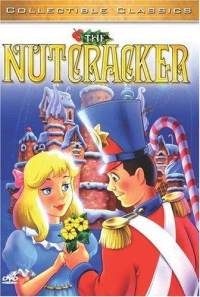
Jetlag's Nutcracker

My paternal grandfather knew I liked the Nutcracker story. A few Christmases, he gave me Nutcracker gifts: the George Balanchine ballet on VHS (yeah, the movie with Macaulay Culkin), the Warren Chappell book, tickets for the Springfield Ballet production, and one year, an animated version on VHS.

I have since purchased that same animated version on DVD, and now will attempt to review it. The production was by Jetlag Studios, a low budget animation studio who would turn out animated movies usually based on public domain materials.

Their Nutcracker starts with a song being sung about a Season of Love and the Nutcracker who became a King and a Little Girl who became a Queen. Then it's to the Stahlbaum home where Marie and Fritz eagerly await to open their Christmas presents. Their parents play around and ask, "if it's time to open your presents, what are you doing in here?" They hurry in and enjoy their gifts, and soon, Drosselmeyer arrives to activate his clockwork castle, which Marie loves, but Fritz loses interest in quickly.

Drosselmeyer points out the Nutcracker on the tree to Marie. Her father demonstrates how to use it to crack nuts, and Drosselmeyer says it belongs to Marie. She decides to only crack small nuts, but Fritz crams the Nutcracker's mouth full of nuts and breaks off some of his teeth. He's unconcerned about what he did. Marie sits up with the Nutcracker, assuring him she loves him and Godfather Drosselmeyer will repair him. However, as the clock chimes, the owl on top of the clock comes to life and turns into Drosselmeyer himself. Mice begin swarming in, led by a seven-headed Mouse King (at last!), who calls for battle on Fritz's toy soldiers.

Drosselmeyer brings the Nutcracker to life and the little wooden fellow calls the soldiers to life. However, the Mouse King manages to shatter the Nutcracker's sword, but before he can give the death blow, Marie throws her shoe at the Mouse King, but hits her head on the toy cabinet and passes out.

Marie awakens in bed and Fritz and her mother don't believe her story about the battle. However, Drosselmeyer arrives with a repaired Nutcracker and proceeds to tell her "how the Nutcracker became the Nutcracker."

A king and a queen with their baby princess Pirlipat called clockmaker Drosselmeyer to rid the palace of mice, but Madame Mouserinks, queen of the mice, swears vengeance that she will deliver on Pirlipat. Despite their guard of maids and cats, Mouserinks gets through and curses the princess. Drosselmeyer and the court astronomer spend 15 years sailing the world searching for a Krakatook nut and a young man who has never shaved or worn boots. They finally find both with Drosselmeyer's cousin. (They left in the part where the cousin tells Drosselmeyer it was fifteen years ago that he got the nut. "LET ME AT HIM!" Drosselmeyer begs.) Drosselmeyer's nephew breaks the nut for Pirlipat, which restores her beauty, after the king agrees Pirlipat will marry the nephew. However, Madame Mouserinks arrives and turns him into a Nutcracker that falls over on her and kills her. With her dying breath, she swears revenge. Pirlipat refuses to marry the Nutcracker, and the king tells Drosselmeyer to leave.

Marie feels sure that her Nutcracker is Drosselmeyer's nephew. But that night, the Mouse King visits her and demands her Christmas candy or he'll chew the Nutcracker apart. She agrees, but her family doesn't believe her, except Drosselmeyer. The next night, he returns and demands more of her things, and she gives in. The next day she tells the Nutcracker she's afraid the Mouse King will take all her things until she has nothing left and he'll be destroyed. The Nutcracker comes to life and explains he needs a new sword. Fritz supplies one (saying "The day may come when I might need a favor, so here." "Thanks, Fritz! You're the best brother ever!" "I know.") and that night, the Nutcracker valiantly slays the Mouse King, giving Marie the seven crowns.

The Nutcracker then takes Marie through a coat sleeve to Christmas Wood, where they eat Sugar Plums that fly like shooting stars, and sail to Lake Rosa, where Marie sees a princess in the water. She thinks it's Pirlipat (and it is for a moment), but the Nutcracker has her look and see that it is her own reflection. Arriving at the Marzipan Castle, the Nutcracker is greeted by his weeping sisters and then he and Marie dance. A song follows about dancing through the night, but it climaxes with Marie waking up in her bed. Again, her parents don't believe her story, even when she shows them the crowns. However, she is declared well enough to leave her bed.

Marie tells the Nutcracker she still loves him, no matter what anyone says. And at that moment, Drosselmeyer enters with a young man who Marie identifies as his nephew, who later speaks with her in private. He reveals he was the Nutcracker, and invites her to rule with him in the Marzipan Castle, and they are transported immediately there.

"You are my love, my dream come true." — Marie

The production closes with a music video composed of clips of the short film with the song, "A Dream Come True."

Despite some of the voices and dialogue not sounding entirely authentic for Germany in the early 19th century, I'm still surprised at how well this production adapts Hoffman's story. Very little is excised, and the production runs at a quick pace, clocking in at under 45 minutes. The animation is passable, nothing Disney-worthy, but there aren't any quickly noticeable inconsistencies, either.

The production is also notable for not using Tchaikovsky's score. The familiar March theme is used in some pieces of music, but usually, it's original music.

It's easy to ignore this one for its low budget and cheap releases, but, while it might be nostalgic sentimentality, I really recommend that this one not be missed.

Saturday, December 10, 2011

Le Fiabe più Belle. — Lo Schiaccianoci

I found this Italian-dubbed anime version of The Nutcracker quite by accident on YouTube. Apparently, it was from a series of videos called Le Fiabe più Belle, or The Most Beautiful Tales. Many stories were in the series, such as The Wizard of Oz and Alice in Wonderland among many classic fairy tales.

This adaptation is quite faithful to Hoffman, though very fast paced. And it appears that, unusual for adaptations, Fritz is actually depicted as the older brother.

But anyway, I can't say much more than that. Here it is:

Friday, December 9, 2011

The Nutcracker Prince

1990 brought the first English big screen animated adaptation of Hoffman's Nutcracker. And what a cast! Megan Follows (Anne of Green Gables) as Clara, Peter O'Toole playing the supporting role of a soldier named Pantaloon, Phyllis Diller as the Mouse Queen, and Kiefer Sutherland (long before 24) as the Nutcracker Prince himself!

The film opens wonderfully with Clara and Fritz delivering gifts around town and going to visit Godpapa (who they also call "Uncle," though they establish he's not really an uncle) Drosselmeyer before they return home for the family Christmas party.

One element often ignored in Nutcracker adaptations appears: the older Stahlbaum sister Louise is present. (She was in Hoffman's book, but as her role is barely fleeting, she is often omitted.) She is being courted, and Clara notes this, partly in scorn, and, perhaps, envy. Clara also has a kitten named Pavola.

At the party, Fritz gets a soldier's hat and a toy cannon. Clara gets a doll she names Marie (it is noted that many times the name of the doll and the girl are exchanged, however, few adaptations I've seen feature the doll by name, if at all). Clara's mother says that this will likely be Clara's last doll: she is about to become a young woman.

Godpapa Drosselmeyer arrives with a magnificent clockwork castle that, when Fritz asks if anything can be changed about it, he covers and pushes away in a huff. Clara finds a Nutcracker among the presents and Drosselmeyer shows her how to crack nuts with it before Fritz takes it and mistakes a toy cannon ball for a nut and breaks off some of the teeth.

As music plays, Drosselmeyer tells Clara the story of why the Nutcracker looks the way he does. (The sequence is animated in a cruder style than the rest of the film and the voices are comically exaggerated.) In a kingdom far away, clockmaker Christian Elias Drosselmeyer and his nephew Hans serve a king who reigns with his queen and their teenage daughter Pirlipat. On the King's birthday, the Queen is making a bleu cheese cake when the Mouse Queen arrives and with her oafish son and all their mice subjects, destroys it. Enraged, the king orders that the mice be killed.


In revenge for killing her subjects, the Mouse Queen curses Pirlipat with ugliness. Blaming Drosselmeyer for his daughter's ugliness, the King is about to have him executed, but the Queen suggests that he find a way to restore their daughter instead. Drosselmeyer discovers the Krakatook nut can lift the curse, if it is broken by a young man who has never shaved or worn boots, if he cracks it with his eyes closed and takes seven steps backwards. (Luckily, there's a Krakatook nut in the Royal Nuthouse.)

The King sends a notice that anyone who can break it may have Pirlipat and the kingdom, but all eligible bachelors fail. In a last ditch effort to save his uncle, Hans attempts to break the nut and does so, but as he walks backwards, the Mouse Queen turns him into a Nutcracker. He falls over, causing a pillar to squash her, and her son's tail. The Nutcracker grows to a small size and the King and Pirlipat banish Drosselmeyer and Hans. The Mouse Queen's son swears revenge to the Nutcracker.

Clara shrugs the story off as a fairy tale, but that night, she returns to the Nutcracker and shows the other toys to him, including the soldier Pantaloon, and her dolls Marie and Miss Trudy. She sings to the Nutcracker (a lovely song that utilizes The Dance of the Sugar Plum Fairy as its melody), but when Pavola breaks an ornament, she turns to go upstairs. However, she sees a phantom-like Drosselmeyer on the clock. He opens his coat and magic flies from him, bringing the toys to life as mice led by the Mouse King (who has been redesigned to look more fearsome, even with just one head) swarm in. The Nutcracker doesn't have a sword, so Clara is forced to defend him against the Mouse King by throwing her slipper at him, but she hits her head against the clock and passes out.

Clara awakens in bed and is told she was found unconscious downstairs. Fritz gives her a half-eaten box of chocolates as a gift which she puts in a drawer. Drosselmeyer arrives with a fixed Nutcracker and vague answers to her questions about the night before. Her mother arrives and insists she needs rest and the Nutcracker should go back downstairs. Drosselmeyer promises to keep an eye on the Nutcracker.

That night, the Mouse King arrives in Clara's room and tells her he's going to chew the Nutcracker to pieces. She offers him the chocolates, but she catches him in the drawer and runs downstairs. Drosselmeyer is back on the clock and the toys reawaken for a second battle, one of the toys lending the Nutcracker a sword. He manages to stab the Mouse King in the chest and the mouse falls from the Christmas tree. However, Pantaloon has been damaged in battle and they must take him to the Land of the Dolls to fix him. Clara is invited to join, and Drosselmeyer shrinks her so she can go with the toys through the clockwork castle.

They are transported to a Christmas Forest full of Christmas trees on the backs of flying swans. Clara and the Nutcracker share a dance in the Candy Castle and he asks her to stay. She's love to, but she reflects that she wants to grow up. Her family and Pavlova need her, and she wants to dance in the ballet. This makes the toys freeze and resume their normal toy appearance. Suddenly, the Mouse King appears, wounded and angry. While the Nutcracker attempts to fight, he is slowly turning back into his wooden form. Clara fights him, and lures him to the balcony where they both fall off, but Clara grabs the edge and pulls herself back up, and sees the Castle abandoned and a mist filling it. She tearfully calls for the Nutcracker.

Suddenly, Clara awakens in her bed, Fritz excitedly telling her how Pavolva caught a mouse. She grabs her slippers and coat and runs downstairs. The Nutcracker is gone. She runs to Drosselmeyer's shop. He opens the door, possibly having expected her, and she begs him to tell her the truth about the Nutcracker and Mouse King, saying she must know what is and isn't real. However, a young man carrying a clock enters from the back room, and Drosselmeyer introduces him as his nephew, Hans.

"Hello, Clara," says Hans, bowing.

"Hello, Nutcracker," replies Clara.

The animation in The Nutcracker Prince is gorgeous (except in the Princess Pirlipat story, but that's intentional), and the voice acting is top notch. While the story deviates a little from the original Hoffman, it works very well as an adaptation.

There are two songs, the afore-mentioned song that Clara sings to the Nutcracker: "Save this Dance." During the end credits, a Tchaikovsky-inspired song called "Always Come Back To You" plays, sung by Natasha's Brother and Rachele Cappelli. Often song sequences can stick out like sore thumbs, particularly if they use a piece of well-known music as a basis. However, these work beautifully.


The Nutcracker Prince wasn't a big box office success, so it's mainly been relegated to a video release, television broadcasts, and low budget DVDs. To be honest, for being one of the best adaptations of the Hoffman story that uses little from the ballet, I'd say it deserves much better recognition.

Thursday, December 8, 2011

Care Bears Nutcracker Suite

I didn't grow up with the Care Bears, so I'm afraid to say I don't have much fondness for them. I have no clue why "Care Bear Stare" shoots a beam from the teddies' chests.

Anyway, the Care Bears were going to have a trilogy of films, and the third film was going to be Care Bears Nutcracker Suite. However, it was released as the 1988 Christmas special and the finale of their TV series.

The special opens with kids preparing for a school production of The Nutcracker and a kid thinking it's boring. When a girl protests that the story can't be changed, the teacher, Miss Walker, says the ballet is just one of many retellings of E.T.A. Hoffman's story. (YES! THEY ACKNOWLEDGE HIM OPENLY!!!) They ask her what her favorite version of The Nutcracker is, and she says it was one told to her by the Care Bears.

The Care Bears discover an unhappy girl named Anna. I'll say it now, the Care Bears creep me out. Anna's best friend Sharon has moved away, so she's depressed. Suddenly, an amnesiac Nutcracker soldier arrives from a black portal, followed by rats (whose leader is the king, but he's short one-headed version) who attack, but the Care Bears use the Care Bear Stare to defeat them. Remembering he's from Toyland, the Nutcracker, Anna, the Care Bears, and Anna's brother Tommy go back to Toyland.

An evil Vizier has been trying to get the ex-Prince of Toyland's magic ring, which the petite Sugar Plum Fairy has hidden from him. Our group of protagonists head to the Vizier's castle, braving small obstacles and even imprisonment, they discover the ring was hidden in a nut by the Sugar Plum Fairy. The nut, after being recovered from the Vizier, is cracked, and the Nutcracker puts the ring on, turning him back into the Prince.

After Anna returns home, she is introduced to the new neighbor, Allen Prince, who looks like the Prince. The children ask what happened to Anna and Allen, when Miss Walker's husband Allen arrives.

Umm.... I guess this works as a Care Bear story, and there's at least a battle with "mice," although they're rats this time, and the Prince reappearing as a person in "the real world." The Rat King describes a battle with the Care Bears and lies that a shoe was thrown at him. But, overall, I didn't have any special feelings for this one. I didn't hate it, but I didn't love it. Or like it really. I'm indifferent. It's like an odd one out on my list of Nutcracker presentations.

At least they did acknowledge Hoffman...

Wednesday, December 7, 2011

Nutcracker Fantasy

Seemingly, people have mistaken this stop-motion film for a Rankin-Bass production. Not hard to see why as the production values are just as good.

There are at least two versions of Nutcracker Fantasy: a Japanese one and an English one. While both are about the same, the English one lacks a few shots deemed too intense for family viewing.

The opening scene is narrated by a woman telling us how when she was a little girl, she loved visiting her Uncle Drosselmeyer in the town of Mindon. She tells about his clockmaking and toymaking, and then about the Rag Man, a Mindon urban legend who turns children who don't go to bed on time into mice.

To be honest, I fail to see the point of the Rag Man sequence as it's such a tiny part of the entire story. He's referred to a few times in passing, and had an additional appearance in the Japanese version. The fact that the English version works without that bit proves just how well it would flow without him.

Anyway, Clara stays up to see Drosselmeyer home, despite the protests of her Aunt Gerda. Clara's old friend Fritz is coming to visit the next day. When warned about the Rag Man, Clara says she's too old to believe. When Drosselmeyer returns, he has an imperfect doll with him that resembles a nutcracker soldier. Clara likes it and wants to have it to sleep with. Drosselmeyer lets her, but that night, she dreams mice are carrying away the Nutcracker. Downstairs, a large two headed mouse queen named Morphia and her son refuse to return them. When a mouse scratches Clara, the Nutcracker comes to life to defend her. The mice flee, and Clara falls asleep again.

Clara awakes in her bed and can't find the Nutcracker. There is also a scratch on her arm. Aunt Gerda thinks she's feverish and sends for the doctor. As Clara thinks over the previous night, she finds herself downstairs and enters the clock, calling for Drosselmeyer. She eventually finds her way into a palace where she is mistaken for Princess Maria. When she reveals the mistake, they explain Princess Maria was placed in an enchanted sleep to slowly turn into a mouse by Morphia. This happened when a marriage proposal between Maria and Morphia's son Gar was refused as part of a peace treaty.

No one in the court seems to have any idea how to break the curse, but Clara is advised by a street singer to visit a gypsy who goes by "Queen of Time." The Queen of Time reveals the only way to break the curse is to break the Shell of Darkness, Morphia's source of power (it covers her heart), with a pearl sword she gives Clara. Clara then explains and gives the sword to Lieutenant Franz. The surprise attack on Morphia and the mice is successful, but just before the Nut of Darkness is destroyed and Morphia killed, Franz is cursed to become a Nutcracker.

Princess Maria, when restored, proves ungrateful to Franz. Clara wants to restore Franz, and a Puppeteer offers to help until he hears it's Morphia's curse, which he can't work against. He sends her to see a Watchmaker, who has one eye. (He looks a lot like Drosselmeyer.) He tells her the only way to break the curse is love. Franz made a sacrifice to save the Princess, and Clara must make an equal one. But does she love Franz enough?

Clara falls asleep and dreams of dancing with Franz, until finally they are about to go up a flight of stairs together. She gets stuck on a stair and Franz goes without her. She awakens to see Gar about to carry off the Nutcracker, wanting revenge for his mother. Clara protests, asking him to forgive Franz. She then offers her life for Franz. As Gar is about to stab the Nutcracker, Clara throws herself in front of the knife, but when it strikes her, Gar is destroyed, Franz is restored, and she finds herself falling into a black hole.

Clara awakens in her bed and Aunt Gerda announces Fritz has arrived. When he enters, he looks exactly like Franz. The two are reintroduced, and we are told they lived "Happily ever after." They are then seen surrounded by the people of Clara's fantasies.

The story is a loose adaptation, though the connections to the original Hoffman story may be seen. While many parts are rewritten, Clara now takes part in what was the Princess Pirlipat story. The battle between mice and toys is now part of that as well, and Clara's willingness to sacrifice for her love is also present. In short, while the story is very, very different, the important themes are there, in what makes for a sound story in its own way.

The weirdest thing to me is Clara's husband being named Fritz, who was her brother in the original story. ... Awkward.

The music is really good. If you listen closely, you'll note riffs off of Tchaikovsky often. Drosselemeyer's "Tick Tock Tee" plays with the classic March theme from the ballet. "Where Does The Blue Bird Fly" has the chorus take off the Final Waltz and Apotheosis.

However, I must say that the casting of Christopher Lee as Drosselmeyer, the Street Singer, the Puppeteer and the Watchmaker was genius. Pure perfection.

Lilies in the night
Move in shadow
Knocking on the door
Calling Clara
Somewhere in the dark
Dawn awakens
To dance a dream of fantasy
Palace of the princess
Deeply dreaming
Midnight minuet
As she is sleeping
Clara, take my hand
Feel the music
Now the dance of the dolls has begun

And in the moonlight
You minuet
Dancing along
In your first pirouet
This is dance of the dolls
And it's all for you...

Tuesday, December 6, 2011

"The Nutcracker" in audio

I have experienced two Nutcracker audio books, both different variations of the story, but very similar in presentation. And both by Caedmon Audio, as well!

The earliest is Story of the Nutcracker, read by Claire Bloom. The back cover gives a brief history of the story, crediting Hoffman, Dumas, and the creators of the ballet. Janet Schulman is the writer of the adaptation presented on the album, which is a very faithful one. Instead of just having a basic condensation of the plot, Schulman's take allows the characters to develop just as they do in Hoffman's book. This adaptation is also available as a book, illustrated by Renee Graef.

In addition to staying true to Hoffman's tale, Schulman also works in some of the entertainments from the ballet, including the Sugar Plum Fairy and the Arabian coffee dancer.

Claire Bloom gives a wonderful reading, backed with music from the ballet. The mix is perfectly edited together. It's a wonderful listening experience, and perfect for anyone interested in the original story.

The other recording is a straightforward reading of the book by Christopher Plummer. The book is Ralph Manheim's excellent translation of Hoffman's original. Again, it is mixed with the music from the ballet, mixed to highlight it.

Plummer gives the story a life of its own. Marie is fittingly dreamy, while when Fritz enters, he reads in a pompous tone, emulating to how seriously Fritz takes his army play. Drosselmeyer is not as mysterious as he could easily be, but is a warm and inviting German nut. I found his reading of the story of Princess Pirlipat immersive.

I highly recommend both recordings!

Monday, December 5, 2011

Щелкунчик (1973)

Russia's animation output never ceases to amaze me. I'd been exposed to some Oz animation and it was fine. But in 1973, they turned out their own adaptation of the Nutcracker. Nothing Disney-worthy, but let's look at it.

Schelkunchik (which translates simply to "Nutcracker") contains no dialogue, and mainly Tchaikovsky's music, though some is from also from his Swan Lake and Sleeping Beauty. This is truly a fine marriage of music and animation. It opens with a soldier mouse searching with a searchlight. He eventually finds a nutcracker on a Christmas tree and smiles, and heads out. Whatever mission he was on has been completed.

Fast forward to Christmas morning. Many children rip open their presents, and use the Nutcracker to crack nuts. Meanwhile, through a window, a chambermaid watches curiously as the children enjoy a lush pastime she apparently never got to. The Nutcracker is soon abandoned as a rich dinner is served.

At night, the chambermaid enters the room to clean up after the party. She mops up, but then quietly begins to dance. The mop joins her, and she finds the Nutcracker on the floor. Admiring him, she gives him a kiss that brings him to life. He greets her, but then realizes he's made of wood. He looks at his reflection in the window and is dismayed at what he sees.

The Nutcracker tells his story: he was a prince, and shortly after his birth, his parents had a party for him. The party is invaded by a cruel three-headed mouse queen and her three-headed son. They are rude, and seem to offer to become friends, offering the baby prince a wrapped gift. The queen unwraps it, revealing it to be ... nothing. The baby cries. The king asks the mice to leave, but they refuse. He sends guards who are petrified and shattered by the mouse queen. The king draws a sword, but the queen eats it out of his hand, so he enters a secret chamber hidden in the wall by his throne to get some poison. The mouse prince closes the door after the king, but the baby's cradle rocks onto his tale. Injured, he cries to his mother who looms over everyone threateningly. She is about to cast a curse, when the king arrives through a hole in the floor the mice had made. He poisons her, which causes her to burst, but her tail flies through the air, striking the baby prince, transforming him into a Nutcracker. Distraught, his mother catches him up and cries over him. The mouse prince grabs his mother's crown and leaves, shaking his fist. Everything in the throne room is frosted over, and the Nutcracker is transported to a Christmas tree.

And now, soldier mice begin to enter the hall and the Mouse King, apparently the mouse prince now grown to an adult, enters. The chambermaid tries to guard the Nutcracker, but the Mouse King uses his magic and shrinks her to his size. The Nutcracker calls the other toys and ornaments to battle, and they fight, the mice being drowned with candy, but the Mouse King uses his scepter to disintegrate all in his way. The Nutcracker is caught and about to be destroyed. The chambermaid throws her wooden clog at the Mouse King, knocking off his crown, which destroys him, creating a mysterious vapor that kills all the mice.

The chambermaid's clog becomes a beautiful shining slipper. The Nutcracker picks it up, and as he does so, his wooden body crumbles, revealing a handsome young prince underneath. He puts on the shoe on her foot, and her other clog transforms into its mate. Then her dress transforms into a beautiful gown, and as the Prince offers her his hand, they are transported through dance back to his old home. The throne room thaws, and the king and queen are thrilled to see their son a normal human being again, and with a beautiful girl at his side. The Prince and his soon to be Princess join in a mesmerizing dance.

Back under the Christmas tree lies the broken shell of the Nutcracker and a pair of wooden clogs.

Now, this is a very loose adaptation of the story. Aside from the Nutcracker and the Mouse King and his mother, none of Hoffman's characters appear. The chambermaid takes the role of Marie, and the children at the party more or less fill the role of Fritz, and in some ways, Marie. The story of Princess Pirlipat is telescoped into a story of how a prince was turned into the Nutcracker.

The thing is, even though it is very loose, it is so well done and the telescoped plot makes so much sense, I actually love it! It's on my list of favorite adaptations.