Monday, March 20, 2017

Something Sweet and Almost Kind: Queer Theory and Interpretation of Disney's Beauty and the Beast

In 1991, Walt Disney Animation Studios brought their follow up to their previous musical animated adaptation of a fairy tale, Beauty and the Beast.

The story had initially been a parable to encourage women into learning to love their husbands they were made to marry by arranged marriage. Ever one to eschew source material for a more marketable story, Disney heavily reworked the story to give both of the title characters more of a sense of agency to the proceedings. Beauty became Belle, a strong, intelligent young woman who speaks for herself. The Beast becomes a vulnerable figure who lashes out in rage but opens up to kindness and eventually, love.

Rounding out the cast were a villain, Gaston, inspired by the character Avenant in Jean Cocteau's 1946 film adaptation of the story, and his sidekick, the buffoon LeFou. Belle has her father Maurice, her horse Philippe, and the Beast's castle is staffed with people who have been transformed into objects, most notably Lumiere the candelabra, Cogsworth the clock, Mrs. Potts the teapot, and Chip the childish teacup.

The storytelling of Disney's version would use a good number of songs that would move the story along or establish the characters (the lone exception "Be Our Guest" being a welcome showstopping spectacular). Key to these and the overall story process was lyricist Howard Ashman, who had worked on the predecessor, The Little Mermaid.

The movie became a hit and became the first and only animated film to ever be nominated for Best Picture at the Academy Awards. A couple of years later, a Broadway musical adaptation premiered, and a few direct to video midquels were released, telling more stories of Belle's time in the castle during the enchantment. Last week, Disney's live action/CGI remake was released.

The remake courted controversy during its press tour when director Bill Condon revealed the character LeFou was gay in this version. Although some balked that a character previously depicted as a comedic buffoon whose name literally means "the fool" would be Disney's first canonical LGBT character, others saw this as pushing a dangerous agenda and called for boycotts. Regardless, the film has already made over twice its budget in its first weekend.

LeFou's story in the new film has been rewritten. While still comedic, he is not such a buffoon, now clearly in love with Gaston, frustrated that Gaston goes after Belle. During the climax of the film when the villagers attack the castle, LeFou is pinned down and left behind by Gaston and decides to change sides, highlighted by saving Mrs. Potts when she falls. LeFou's story is one that many LGBT people know too well, loving someone who doesn't love you in return.

But the queer influence in Beauty and the Beast was already there. Howard Ashman was a gay man who had AIDS and died before the animated film was completed. And it's believed that the Beast's living under the enchantment became an allegory for living with AIDS.

Life for people with AIDS was lonely, and finding love appeared to be impossible because not only was it a contagious death sentence (access to more effective medication was a few years away), but public knowledge of it was so poor. It was a scary thing, just like the Beast's appearance. In addition, the Beast's curse is depicted as degenerative: if he doesn't love and earn love in a certain amount of time, he will become a Beast forever with no hope of recovery. (The musical adaptation suggests that his violent outbursts are a symptom of the curse about to become permanent.) It is not until the Beast recognizes Belle as an equal that he can hope to have the curse broken.

Belle's love as a cure for AIDS might not be the easiest analogy, but the allegory really becomes strong in the third act when Belle reveals the existence of the Beast to the villagers. Despite her claim that the Beast is kind and gentle and her friend, the toxic male Gaston makes the baseless claim that "The Beast will make off with your children! He'll come after them in the night! ... I say we kill the Beast!" This launches "The Mob Song," in which the villagers give into fear, and inflate the believed threat the Beast poses, ending with the line, "And fifty Frenchmen can't be wrong," suggesting that as a majority, they must be right.

Substitute the idea of the Beast with the LGBT community, and the parallel draws itself. The Beast and his servants seek only to live peacefully and better their lives, but they're being made out to be a danger and being unfairly persecuted. (The new film makes it clear that the villagers would be the friends, family and neighbors of the staff if not for the curse.) One might even try to compare the raid on the Beast's castle to the Stonewall Riots.

Gaston's defeat is by the Beast having Gaston at his mercy but choosing to let him live, proving that he is not the monster he has been made out to be. Gaston, however, stabs the Beast in the back (a traditionally cowardly move), then loses his footing and falls to his presumed death. Perhaps this is hopeful thinking on Ashman's part when the allegory is considered.

I could say more about the LGBT people who have worked on the various iterations of the Disney version of the story, or the cross-dressing attack the Wardrobe uses ("Be free!" she cheers in the new film), but that's really going into semantics. The point is that Disney's version of the story already has queer fingerprints and they aren't going anywhere.

Thursday, March 16, 2017

Comic Book TV Recap (3/14/2017 - 3/15/2017)

Supergirl, Powerless and Riverdale are all taking the week off.

The Flash: "Into the Speed Force" - Barry heads into the Speed Force to save Wally, but the Speed Force uses faces of people who have died to tell Barry that a speedster must stay trapped in the Speed Force. Jessie takes on Savitar and discovers a secret about him.

Legends of Tomorrow: "Moonshot" - The Legends find Henry Heywood (Captain Steel) working on the Apollo 11 mission, and he reveals his piece of the spear is on the flag that will be left on the moon. There's just one little surprise for the Legends: Eobard Thawne is on board the spacecraft, and soon, so is Ray. The Legends and Captain Steel work together to prevent the Legion of Doom from getting the spear and helping history go on as usual. Vixen discovers something about her future.

Arrow: "Checkmate" - Oliver discovers that Adrian Chase is Prometheus and desperately looks for ways to corner him. Felicity's new hacker friends make a dubious request from her.

Legion: "Chapter 6" - David and his new friends find themselves back in Clockworks Hospital, but things have changed, raising more questions from all of them.

X-Men Origins: Wolverine - Widely considered one of the worst X-Men movies, this movie was the first produced after X-Men: The Last Stand. It was supposed to be the first of a series of X-Men prequel films, the next being set to focus on Magneto before that project was folded into the soft reboot X-Men: First Class.

The movie shows us the early days of James Howlett (Troye Sivan as a child, Hugh Jackman as an adult), who has claws that come out of his hands. After fighting in several historic wars, James and his brother Victor Creed (Michael James Olsen as a child, Liev Schreiber as an adult) join a taskforce of superpowered individuals that completes a strange task. After splitting up, the team begins disappearing. Going by "Logan," James finds romance until his new lady friend is apparently killed. Taking a strange offer for revenge, he has adamantium fused to his skeleton. Discovering he's been tricked, Logan flees and plans revenge.

The movie is a little overstuffed with a plot about William Stryker (Danny Huston) putting the powers of multiple mutants into a singular mutant, which gives us an X-Men team prequel that was immediately retconned by the next X-Men movie, as Scott Summers/Cyclops (Tim Pocock) is one of Stryker's abductees and leads a group of escapees as he hears telepathic commands by a wheelchair-less Charles Xavier (Patrick Stewart). And the mutant they dump the powers into? It's a former katana-wielding assassin named Wade Wilson (Ryan Reynolds), and he is called the Deadpool.

So, the plot isn't exactly original or exciting. It's serviceable. But the clumsy reworking of fan favorite characters really killed it for fans.

Tuesday, March 14, 2017

Comic Book TV Recap (3/6/2017 - 3/9/2017)

Arrow is taking a week off. Due to inclement weather, I had to wait until Friday to watch the Thursday shows.

Supergirl: "Exodus" - Kara and Alex are both tested at their jobs as Cadmus rounds up aliens from the DEO's registry, intending to send them to the other side of the universe.

The Flash: "The Wrath of Savitar" - Still trying to stop Iris' future death at the hands of Savitar, Julian helps the STAR Labs team contact him.

Legends of Tomorrow: "Land of the Lost" - While Nate, Ray and Amaya search the Cretaceous period for a missing piece of the Waverider, Sara and Jax enter Rip's mind to find where the next piece of the spear is.

Legion: "Chapter Five" - David's friends discover more about his powers and just how dangerous they are.

Powerless: "Cold Season" - While Cold-themed villains besiege Charm City, Van enlists Ron to help impress his current girlfriend by having him assemble toys for her children. Emily convinces Teddy to submit his heated gloves for a contest.

Riverdale: "In A Lonely Place" - The town searches for Polly as Jughead attempts to reconnect with his father.

Logan - The movie set to say goodbye to Hugh Jackman's take on Wolverine is set in 2029. Most mutants are dead. Logan (Hugh Jackman) drives a limo (Uber-style) to pay for medication for Charles Xavier's (Patrick Stewart) medication to stave off seizures, which makes everyone nearby have them as well. He gets a job to take a little girl (Dafne Keen) and her "mother" up to Canada, and his hand is forced when it's revealed that she has mutant abilities rather like his own, including adamantium-coated claws coming out of her knuckles and feet when she fights.

Logan is the second lower budget R-rated entry in the X-Men film franchise. (Unadjusted for inflation, it is the third-lowest budget of the franchise, behind Deadpool at $58 million and the first X-Men movie at $75 million. Logan's budget is $97 million.) The film is allowed to go all-out, but director James Mangold has taste. The violence is graphic, but not gratuitous and branches out of the story. The characters use profanity not as highlights, but naturally in their dialogue, which for Charles and Logan, feels very organic for where they are now, the tired, aged and broken-down men that they have become.

Which is very good. We have a movie from a superhero franchise that treats its main characters not as superheroes, but as people. The story is well-paced, very character driven, and even has quite a few twists. It's a well-done film that makes us say, "Keep this up, and we won't mind that you're keeping the X-Men from joining the MCU."

Sunday, March 5, 2017

When We Rise review

The culmination of a four year project is an eight hour miniseries written by Dustin Lance Black, who wrote the Harvey Milk biopic Milk. The movie focused on Harvey Milk's political career and gay rights activism in San Francisco before his murder. The movie was unique in finding ways to cut actual footage of the real events along with the re-enactment nearly seamlessly.

That same effect is very apparent in When We Rise with news and other footage being used to define the different times of the over 40 year period the series depicts.

The series follows the lives of a handful of activists based in San Francisco: Cleve Jones, a young man from Arizona who wound up working with Harvey Milk's campaigns and after his death had to carry on the work during the AIDS crisis, including beginning the AIDS memorial quilt. There is also Ken Jones, an African-American Vietnam veteran whose position as a black man and a veteran would often keep him from living openly, who would eventually find himself homeless after his partner dies before deciding to use his experience to help homeless youth as well. Also depicted are Roma Guy and her eventual wife Diane who would both lead in activism for women and LGBTs as well as healthcare access, and also start a family on their own. Finally, a transgender character is found in Cecilia Chung, a healthcare advocate.

The series details the lives of these characters, showing the world they lived in and what they had to deal with, from fighting for rights for housing and employment to federal assistance for AIDS research all the way to the fight for marriage equality. The series closes after the repeals of the Defense of Marriage Act and California's Proposition 8.

The series is of course well-produced, although the look of the series is decidedly for television, and while well-shot, doesn't have the same richness as some dramas and other shows.

Many naysayers on gay issues criticized the show (sight unseen, of course) as liberal propaganda. However, the show avoids trying to skew towards any bias on political issues. George W. Bush doesn't come off looking nice for insisting on traditional marriage, but neither does Bill Clinton for allowing Don't Ask, Don't Tell and the Defense of Marriage Act to be passed. Obama's declaration of support for same-sex marriage is displayed not as a token in his cap, or a Democrat's cap, but as the first president to voice this support, which is simply the fact.

Pro-gay folks still had their criticisms. Of the four main activists depicted, only one is a person of color. Black hasn't commented on this that I've seen, but I think it's worth noting that he focused on true life stories and their real names were being used, so this was likely a byproduct of narrowing down a cohesive, multi-faced narrative of people who were also willing to sign off on being depicted in the series. While Black assured the audience via Twitter that there were trans and bisexual people being depicted, it's a little difficult to spot them, especially the bisexuals. The choice to jump forward a decade through the 1980s and the worst of the AIDS crisis was also criticized. I'm sure this was done as a narrative choice, and there are other readily available sources on this period of time.

When We Rise isn't an all-encompassing history of the LGBT rights movement, but instead a compelling view of how the world changed for a marginalized group in the course of over just forty years, seen through the eyes of a handful of individuals who lived through it. Black assures us that there are many other fascinating stories, more viewpoints that he wants to help get out there. Some of the backlash for just a miniseries lets us know that there are people who need to open their ears, eyes and hearts to our stories, because for all the gains this community has made, there is a lot of work yet to do.

The final shot shows text reading that the rights of LGBTs, women, people of color and religious minorities are still under attack. This final message reminds us the need for intersectional activism, and as Whoopi Goldberg has stated, "If someone doesn't have civil rights, none of us do," reminding us that rights given only to certain people are not rights but privileges.

Friday, March 3, 2017

Riverdale - "Faster, Pussycats! Kill! Kill!" recap

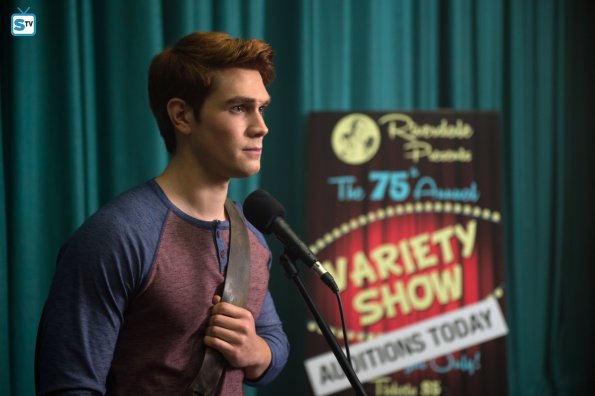
Archie switches from singing with Veronica to singing with Valerie from the Pussycats for the town's Variety Show. Veronica sees her mom kissing Archie's dad. Betty and Jughead discover what became of her sister, Polly.

So far, Riverdale has impressed me with how it updates the Archie characters and puts them into a Twin Peaks-like drama and yet generally stays true to the characters fans of the comics have known for so long. (There's a couple exceptions. Jughead—longtime relationship-free character, recently called asexual in the comics—kisses Betty in this episode.) I've long thought the Archie characters would lend themselves to a TV show well, and while Riverdale is quite different from the show I'd imagined, I can't say I'm not liking it.

Thursday, March 2, 2017

Comic Book TV Recap (2/27/2017 - 3/1/2017)

Powerless is taking the week off. A recap of Riverdale will be posted separately.

Supergirl: "Homecoming" - Kara rescues her father from Cadmus, but Mon-El is suspicious, and as the Danvers family and DEO adjust to having Jeremiah back, strange behavior is noted. Mon-El's suspicions put a strain on his relationship with Kara.

The Flash: "Attack on Central City" - Barry and his friends discover that Grodd and an army of gorillas are planning on invading Central City with help from Gypsy. Jessie tells her father that she's staying with Wally on Earth-1. HR and Harry clash. Iris makes Barry promise that he won't kill anyone in his attempts to save her life. 

Arrow: "Fighting Fire With Fire" - As the revelation of Oliver's tampering with records becomes public, impeachment proceedings begin and Oliver is forced to make one of the most difficult decisions of his career. In addition, a new villain is out for Oliver. Felicity and Thea have to  re-evaluate their methods.

Legion: "Chapter Four" - David won't wake up, but using Ptonomy's powers, they venture into his memories again to find them damaged, finding more questions and a few answers about David's powers as David explores his mind himself.

Guardians of the Galaxy - Film number 10 in the MCU was being predicted to be Marvel's first flop. The characters were virtually unknown, any recognizable talents were only secondary characters or were voicing CG characters or being covered in makeup. In addition, the story would be very separate from the world we'd seen in The Avengers and the films that had just served as direct sequels.

The film follows the exploits of junker Peter Quill (Chris Pratt), aka Star Lord, who had been abducted from Earth years before by an alien named Yondu (Michael Rooker). After finding a mysterious but much sought after orb, Quill is thrown into jail along with assassin Gamora (Zoe Saldana), the raccoon-like Rocket (Bradley Cooper), and a talking, walking tree-like creature called Groot (Vin Diesel). They break out with the help of Drax (Dave Bautista) to meet the Collector (Benecio Del Toro) before running into Ronan the Accuser (Lee Pace), who plans to use the gem inside the orb to lay waste to innocent planets.

The movie quickly introduces the characters, mainly following Quill as the lead, and keeps up a fast pace with action, humor and a good bit of pathos and character building as the five members of the team come together. Not to mention, the movie brilliantly uses a retro soundtrack having hits from the 70s and 80s play as we explore alien planets and outer space with Quill and the gang. Even watched independently of the rest of the MCU, it's a great time for all.

Avengers: Age of Ultron - The sequel to The Avengers was heavily anticipated, mainly because of the first movie's success with audiences, critics and the box office, and with the cast and crew returning, expectations were high.

The movie finds the Avengers retrieving Loki's scepter from a HYDRA base, running into a pair of "enhanced" twins—Pietro (Aaron Taylor Johnson) and Wanda Maximoff (Elizabeth Olsen)—along the way. Analyzing the scepter, Tony Stark (Robert Downey Jr.) believes it holds the key to completing his Ultron project: an army of robots that will ensure world peace. This goes awry as the required AI suddenly develops itself. Taking a singular sentience over a growing army of robots, Ultron (James Spader) begins to enact his plans for world peace: there will be no problems if there are no humans left. Putting each of their strengths to work, the Avengers join with new allies as they set out to save the earth again.

The reception of the movie was tempered at best. Some enjoyed it, others were far more critical. Ultron—a formidable foe in the comics—didn't feel as if he met his full potential. A romance between Natasha Romanoff (Scarlett Johansson) and Bruce Banner (Mark Ruffalo) featured in the film with little to no set up in previous films and didn't really serve the characters' stories well. Clint Barton (Jeremy Renner) is given a family, again with no set up in previous films, and contradicting a common fan theory that he and Natasha were a couple.

Another problem with the movie is that it was near the end of Phase 2. A lot of the films in Phase 2 were spoiled with the knowledge that there would be future films. By the time Age of Ultron was in theaters, fans knew about future films, so the threat of Ultron causing an extinction-level event was ruined by the knowledge that of course the plan wouldn't pan out. The question "Are they all going to die?" is pointless when you know the answer is "No." This is the same problem with Thor: The Dark World. Phase 2 had the problem that it wasn't a beginning or an end, but simply a continuation. The highlights of Phase 2 to most fans are Captain America: The Winter Soldier and Guardians of the Galaxy because the former severely changed the world of the MCU, and the latter was disconnected enough from it to do nearly whatever it wanted.

Is Age of Ultron horrible? No, on its own, it's still a very good superhero movie, and it introduces three new heroes to the MCU, gives us our first mention of Wakanda and the first glimpse of a future villain, and moves the plotline of the Infinity Stones forward. It has its flaws which are very apparent, but it's not "skip it" bad.

Ant-Man - There had been quite some history with this film. Popular action/comedy director Edgar Wright had been developing an Ant-Man film since about 2003 and had been hired in 2006 to direct and began a long development process before the film was announced for a 2015 release. After casting Paul Rudd as the lead and preparing to shoot, Wright left the film, he and Marvel Studios citing creative differences. Director Peyton Reed took over and Paul Rudd helped rewrite the script. People weren't sure about the obscure hero, some were made aware of controversies in the character's past and made up their minds to skip the movie.

Scott Lang (Paul Rudd) gets out of jail, and is desperate to get back on his feet, which isn't easy for an ex-con. His friend and roommate Luis (Michael Peña) gives him a tip on a heist he can pull, but all Scott gets away with is a strange suit and helmet. Trying them on, Scott discovers they can make him shrink to the size of an insect. He soon meets the owner/inventor of the suit, Hank Pym (Michael Douglas) and his daughter Hope Van Dyne (Evangeline Lily), who recruit him to infiltrate Pymtech to steal the prototype of the Yellowjacket, a suit and formula that builds on Hank's work and weaponizes it.

Ant-Man wisely keeps its focus small. In addition to learning to master the suit and communicate with ants, there's a big focus on being a father. Hank and Scott have messed up with their daughters. Cassie still devotedly loves her father, while Hope and Hank have some problems they need to iron out. In addition, the movie is also very humorous but wisely balances the proceedings with enough pathos to tell the story of how Scott not only becomes Ant-Man but how he and Hank become better men. A very good closer to Phase 2.

Captain America: Civil War - This movie proved to be quite the controversial choice to open Phase 3. The Civil War comic story had been a massive story that built on the Marvel Universe and many fans were displeased about how characters acted as the government required superheroes to register with them. Promotion of the movie made it clear that the story would deal with the consequences of collateral damage, which appeared to be a factor in the movie Batman v Superman: Dawn of Justice, which had originally been scheduled to open in 2015 and then was pushed back to a couple months before this movie.

The directors would reveal that the decision to base the third Captain America film on Civil War seemed to actually be spurred by the announcement of Batman v Superman. While some fans of DC Comics' properties saw this as Marvel trying to copy, it would be more fair to see that Marvel saw the other film as something that could set new standards for superhero movies and needed to do a story big enough to keep up. Fans will likely debate for ages as to which film did it better, but I won't do that here.

The character Spider-Man had been a major part of the comics story, but being one of Marvel's most famous characters, the rights to him had long been licensed to Sony Pictures, who had recently begun a second film series based on the character, making him unavailable for Marvel Studios to use. However, Marvel was in close contact with Sony, and their current plans for Spider-Man were in flux. Their current Spider-Man actor had been fired after not appearing at a Sony event and the latest Spider-Man film had been successful, but had not reached the expected profit margin. So, Marvel offered to take over production of a new Spider-Man film series that they would produce for Sony in exchange for letting Spider-Man appear in some of their films. Sony ultimately agreed to the deal. Captain America: Civil War would introduce Spider-Man to the MCU along with Black Panther.

After a mission in Lagos, Nigeria goes wrong, the deaths of several people from Wakanda are blamed on the Avengers. In response, governments across the world agree to ratify the Sokovia Accords, which would put the Avengers under government oversight. Tony Stark (Robert Downey Jr.) remembering that he caused many deaths by creating Ultron, decides to go along with it. Steve Rogers (Chris Evans) decides against it as he states, "We may not be perfect, but the safest hands are still our own" and citing the loss of freedom of choice and possible government corruption as another reason. However, Steve's attempt at retirement is cut short when there's an explosion at the United Nations building in Vienna that kills T'Chaka, the king of Wakanda (John Kani). The bombing is pinned on none other than the Winter Soldier, the revived and HYDRA-influenced and enhanced Bucky Barnes (Sebastian Stan). Wanting to question Bucky himself, Steve goes after him, and soon has to shield him from the government, his former fellow Avengers, the new king of Wakanda, T'Challa (Chadwick Boseman), and Tony's new recruit Peter Parker (Tom Holland).

Captain America: Civil War has a large scope and an even bigger cast (all of the Avengers except Thor and Bruce Banner/Hulk appear in the film), but it doesn't lose focus on its main narrative of Steve seeking the true culprit of the UN bombing. Thematically, it wraps up the story of Captain America in the MCU, reminding us that it's never been about the colorful costume or the shield, but the man. Like Winter Soldier, it changes the status quo of the MCU and instead of giving us a neat, pat ending, it leaves the door wide open for questions and further developments that fans still want to see. A very good start to Phase 3.

Thursday, February 23, 2017

Comic Book TV recap (2/20/2017 - 2/23/2017)

Heads up for next week: I'll be watching the miniseries When We Rise on ABC, so recaps of Powerless and Riverdale will be posted as a separate blog as I won't be watching the night that they air. Also, Legends of Tomorrow will be taking a week off next week and Agents of SHIELD is taking a hiatus before they get into their third storyline of the season.

Supergirl: "Mr. and Mrs. Mxyzptlk" - Mr. Mxyzptlk arrives from the Fifth Dimension to take Kara as his bride, trying to woo her. But Mon-El is ready to fight. Alex wants to celebrate Valentine's Day with Maggie, who doesn't care for the holiday. Winn gets a date with an alien.

The Flash: "Attack on Gorilla City" - Jessie Quick comes to STAR Labs from Earth-2 to report that her father is being held in Gorilla City, where the gang left Grodd last season. Arriving there, they are captured and are told that they must fight in an arena against the leader of the City and defeat him or they will be killed. Wally and Jessie patrol Central City and Wally confesses his feelings for Jessie.

Legends of Tomorrow: "Camelot/3000" - The quest for the Spear of Destiny takes the Legends back to Camelot, where mind control devices have been used to turn Arthur and some of his knights against the rest of the kingdom by the Legion of Doom. Ray gets a little too involved in the heroics of the day as Mick helps Jax and Dr. Stein reverse engineer the devices.

Agents of SHIELD: "Self Control" - Most of the team at SHIELD have been replaced by LMDs, and Daisy and Simmons have to find who hasn't been replaced and try to find a way to rescue their team mates in an engaging winter finale.

Arrow: "The Sin-Eater" - As some of Oliver's previous (female) baddies escape prison, Oliver's world gets a little more difficult as a reporter has been clued in that he is the Green Arrow. Also, word gets out that Oliver's office covered up the death of an officer who was killed by Prometheus, but made to look like the Green Arrow's victim.

Legion: "Chapter 3" - David and his friends journey deeper into his memories and find many new puzzles as the story begins to come together.

Powerless: "Emily Dates a Henchman" - Emily gets swept off her feet by a dashing gentleman she meets in a bar, only for her coworkers to reveal to her that he's a henchman. After Teddy and Ron find a batarang, Van tries to use it to get Batman to pay up for repairs on a damaged car.

Riverdale: "Heart of Darkness" - As the Blossoms have a funeral for Jason, tensions rise about how his killer is still walking free. Archie is offered the chance to become captain of the football team and has to decide how to balance his place on the team and his musical pursuits. Hermione Lodge gets a shocking message while Veronica gets to know Cheryl better. Jughead and Betty stumble upon new information in their investigation of Jason's death.

Iron Man: Rise of Technovore - This is one of two Marvel anime movies by Madhouse Studios, following several anime series. This one finds the launch of a Stark satellite called Howard is sabotaged, and Rhodey is feared killed. Tony discovers it's the work of Ezekiel Stane, who has merged with his nanobots he calls Technovore. As Tony works on his own to stop Ezekiel's plot, Nick Fury sends Black Widow and Hawkeye after him, forcing him to turn to the assistance of Frank Castle, the Punisher.

This is clearly meant to be in a continuity all its own, though it's easy to see the MCU films (this was released just before Iron Man 3) as backstory. I found the story rather odd, some scenes rather dreamlike, and the tone pretty dark. I'm not an anime fan, but I don't object to it. This is not one for younger viewers, but viewers should be aware of what they're getting into.

The Lego Batman Movie - After four movies that present a dark, grim Batman, The Lego Batman Movie comes as a breath of fresh air. It's a spinoff of The Lego Movie, which is set in a somewhat self-aware world made of LEGO pieces and characters, where virtually every property that was ever made into a LEGO set can and do crossover. After several direct-to-video shorts and films featuring the DC heroes in LEGO form, this one focuses on Batman, offering a tongue-in-cheek new Batman adventure that celebrates Batman's history.

As Batman celebrates a long career of keeping Gotham safe, Alfred points out that he still has issues about having a family, which gets complicated when he accidentally adopts orphan Dick Grayson. Commissioner Gordon retires and is replaced by his daughter Barbara, who proposes that Batman work with the police for more effective crimefighting. Batman decides that to stop the Joker once and for all, he needs to send him to the Phantom Zone.

This satirical, high energy and just plain fun take on Batman delivers in much the same way the 1966 Batman TV series starring Adam West did, except this has some character development for Batman. It's imaginative but not stupid and has laughs for all ages. Definitely recommended, and a great start for the superhero movies of 2017.

Iron Man 3 - The third Iron Man film launched Phase Two of the Marvel Cinematic Universe and currently seems to have set the standard that there will be no more than three solo films per character. It could change, however. This installment was directed by Shane Black, taking over from Jon Favreau, who still appears in the film as Happy Hogan.

Tony Stark (Robert Downey Jr.) is dealing with PTSD from his heroic acts at the end of The Avengers and he's not dealing with it well as he spends much of his time in his workshop building new suits of Iron Man armor, even discovering how to use his armor remotely. Aldrich Killian (Guy Pearce) makes a proposal to Pepper (Gwyneth Paltrow) about working with his new Extremis technology to hack DNA and improve humanity. Meanwhile, the United States is threatened by a mysterious terrorist called the Mandarin (Ben Kingsley) via video messages. All is certainly not as it seems to be, and when Tony's California home is attacked and destroyed, he finds himself in Tennessee without a fully functioning suit and believed to be dead. Tony must finally address what makes him Iron Man and a hero: his armor or something else?

Again, Iron Man 3 fails to satisfy as a sequel but works better as a chapter of the MCU. The film is well done and brings more of the world of Iron Man to the big screen, but a lot of fans were disappointed at the use of the Mandarin character. (Marvel would reveal that there is actually a more mysterious, secretive Mandarin, but they have yet to be seen.) The film gives a good wrap up to focusing on Tony's story, though it will continue in later films, wisely leaving it open-ended. Perhaps it is because it leaves us wanting a bit more that the movie doesn't get a lot of love...

All Hail The King - A Marvel One-Shot found on the bonus features of Thor: The Dark World follows Trevor Slattery (Ben Kingsley) as he spends time in prison and is questioned about his career and what he knows about the Mandarin. I wasn't watching the other One Shots this time around, but this one sets up a tantalizing possibility for a future MCU villain.


Thor: The Dark World - As Loki (Tom Hiddleston) sits in prison in Asgard, Thor (Chris Hemsworth) works to bring peace back to the Nine Realms. However, there is a convergence of the Realms happening, reawakening Malekith the Dark Elf (Christopher Ecclestion), who wants to use a mystical substance called the Aether to plunge the whole of reality back into darkness. Thing is, the Aether has joined with Jane Foster (Natalie Portman), who Thor has taken to Asgard. When the Dark Elves attack Asgard and cause a devastating loss, Thor has to pull together a last ditch effort to save not just themselves but all of the Nine Realms. He calls on Heimdall (Idris Elba), Jane, Lady Sif (Jamie Alexander), the Warriors Three and his adopted brother and former enemy Loki.

Thor's second film gets even less love than the first one. Despite the stakes of the story, the film never feels that serious. In addition, Malekith gets little screentime much less development, fans pointing to Loki's presence diminishing the character. It's hard to argue with that, but despite those shortcomings, the film is still another enjoyable and often exciting Marvel adventure, and sets up further things to come in the Marvel Cinematic Universe and Thor's own story.

Captain America: The Winter Soldier - Still adjusting to the 21st century, Steve Rogers (Chris Evans) works closely with SHIELD, making a new friend in Sam Wilson (Anthony Mackie) and going on missions with Natasha Romanoff (Scarlett Johansson). That said, Steve questions a global surveillance program called Project Insight. When Nick Fury (Samuel L. Jackson) has his own questions about the project, he's suddenly attacked. Steve and Natasha join forces and go on the run as they discover the Red Skull's organization HYDRA might not be as dead as they thought. In addition, a face from Steve's past that he never expected to see again shows up.

Few fans were complaining about this film! A tightly focused plot and exciting action, good character development for the characters, plus the introduction of Falcon and the Winter Soldier to the big screen all left audiences very satisfied.