I'd first heard about G.B.F. due to an outcry about its MPAA rating: R. People were upset about it because it doesn't contain language, sensuality or nudity that you wouldn't see in a PG-13 rated film. There's just one difference between G.B.F. and most other movies like it (critics automatically compare it to Clueless and Mean Girls): same-sex relationships and attractions are a huge theme in the movie with at least four gay male characters. Thus, critics of the rating maintain, the R rating isn't so much about language, violence and sensuality so much as it is about the movie being—well—gay.
The movie came out in a limited theatrical release last month and on video on demand services. While I could have streamed the movie, I opted to wait for the DVD release (independent movies—and most LGBT-themed films are—aren't so likely to get Blu-Ray releases, I've noted). If I shell out my money for something, why not something I can keep?
There has been some discussion over the film: is it perpetuating stereotypes? The film's trailer seems to show the film as a piece about a high school boy who comes out of the closet and becomes a toy for the popular girls at school. To an extent, that's what happens, but the film actually has a message behind it that goes beyond petty high school status symbols.
The film opens with two best friends: Tanner (Michael J. Willett) and Brent (Paul Iacono) who both happen to be closeted gay teenage boys. When the popular girls at school realize they could use Guydar (a sanitized Grindr-ish app) to see if any of their classmates might be gay, Tanner is forced out of the closet and into their friendships.
At first, Tanner enjoys his new popularity: hanging with the coolest kids who try to find him hot dates, but soon he realizes that he has no time for his old friends who were his friends because of who he was, not because he was gay. Stirring up the plot is the upcoming prom, organized by the religious McKenzie Price (Evanna Lynch), who isn't interested in letting boys bring boys to the prom.
The film comments a lot about how people, even in acceptance, don't quite understand how to treat gay people. Your gay best friend is not an accessory or a statement: they are a person. Brent's mother (Megan Mullally) hears that her son is gay (though she already figured it out), and instead of having an earnest talk with him to build understanding, she treats him with nervous acceptance and tries to bond with him over gay movies that he's not in the mood for. (She offers hilarious commentary over Brokeback Mountain.)
In response to McKenzie's anti-gay rules for prom, Fawcett (Sasha Pieterse) decides to start an "all-inclusive" prom, but explains that "to be all-inclusive, we have to be exclusive," when Tanner notes that she turns away prom applicants. Caprice (Xosha Roquemore) wants to break the rut of white prom kings and queens and noting Tanner, decides to add "straight" to the list of things to change up. Perhaps their aims are admirable, but their methods are seriously flawed.
Even trying to out someone by association or stereotypes is made a point of: a friend of Tanner's is believed to be gay, even though he's straight. In contrast, Brent is made out by many to be straight, even though most characters suspect that he's gay.
While the writing is full of these nice messages (a short exchange even points out that few would be supporting a lesbian prom queen), the overall quality is rather rough. The Wikipedia entry for the film suggests that the script was rewritten little if at all from its first submitted draft (it was entered to a contest), and the film was shot in less than three weeks, leaving little time for the story to be further developed. As a result, the film certainly has its flaws. Sometimes the action onscreen seems to be quite stilted, but fortunately, no notable cringe-worthy performances.
Despite that, however, G.B.F. is worth a watch at least once. Amazon, Vudu and iTunes let you rent it starting at $4, and in a year or so, it might be up on Netflix or Hulu.
Saturday, February 15, 2014
Monday, January 6, 2014
Thoughts on current and recent gay issues
Well, I haven't been busy here, aside from those Babes in Toyland blogs. I still find it funny that at Christmas 2011, I published a number of blogs about the Nutcracker; 4 months later, "I'm gay." I did discover, however, that your brain doesn't fully understand love until you're 25, which was the age I was when I came out, so maybe it wasn't actually a bad thing that it took me that long. (There are, however, some things I've said in the past that I now really wish I hadn't...)
That said, the world surely has had some big movements in the areas of LGBTQ rights. Marriage equality made a major victory last summer (ah, Summer, I think, with a -6 degree temperature outside), and a number of states and countries have opened up to same-sex marriages. Good stuff. However, a currently developing case is Utah, which briefly allowed same-sex marriage over the past few weeks. Currently, it's blocked until it can be fully reviewed by a court, possibly the SCOTUS. Of course, my hope (and the hope of many LGBT folk) is that the SCOTUS will soon (rather than later) rule that the legal right of marriage is not to be restricted to a man and a woman, dissolving any bans on same-sex marriage.
Russia proved unreceptive, pretty much banning any public display of homosexuality. It's been a big issue with the Olympics planned to be in Russia in 2016 and the hosting country suddenly saying that they won't permit people to proudly and openly identify their sexuality. I definitely disagree with Russia's law and am curious as to what this says about the Olympic spirit. I hope Russia can change.
Speaking of the Olympics, Olympic diver Tom Daley recently revealed that he was in a relationship with a man, choosing not to label himself as gay, straight, bisexual, flexible or queer. He mentioned that he still "fancied girls." It's been more or less confirmed that his boyfriend is about 26 years his senior: Dustin Lance Black. Some have been critical of this pair, my thought is: I'm not in this relationship, I have no say in it, and personally, I would not mind dating an older man. (Though I do have to admit that if they're over 50, I'm a little disturbed because that's how old my parents are!) Good luck to Tom and Dustin!
And speaking of older men, there was no end to the Facebook chatter about Duck Dynasty's Phil Robertson's being asked of his opinion of homosexuality and civil rights for a GQ profile. Basically, while I do find Phil's words bigoted and insulting, I'm a little more disturbed about his breaking down a romantic relationship to "what orifice would I prefer to put my penis into?"
Another person is not a place to put my penis. That would be my underwear. While I'm sure I would enjoy it, sex is not my prerogative in finding a partner. Having someone who complements my personality is more like it.
And what do I think of the controversy around Phil? GQ loves it because it got people looking at their magazine and website, A&E loves it because it got their show more publicity, and anyone selling Duck Dynasty merchandise (and it's just about everywhere, I kid you not, I saw Duck Dynasty cookies today) will appreciate hopefully moving some merchandise. This whole thing's pretty much been a publicity stunt. And don't say "freedom of speech," when the guy was "suspended" for about a week from a show that wasn't in production at the time and his words were spread everywhere. He was free to say what he wanted, just not while representing the hand that signed his paycheck. And others were free to disagree.
Transgender rights have become a topic of discussion recently. I have a transgender friend myself who has talked to me pretty openly about her transition. Fortunately for her, she lives in Canada where they seem to be a bit more friendly about this issue. In the US, it's a different matter. I have no idea what it must be like to identify as the opposite gender, but the thing is that I'm not transgender. But because someone is going through something I don't fully understand, it doesn't mean that I should devalue it, whether it's a transgender friend or a woman on her period or having discomfort with pregnancy. For those reasons, I support transgender people.
Speaking of pregnancy, next June I'll be the uncle to a new niece or nephew from my sister and her husband. (I already am one to my beautiful niece Amber.) And on the topic of family, my mom and I have been talking a bit more, and without me bringing it up, she's said she's becoming more comfortable with the idea that I won't have a wife and kids and might in fact be dating another man someday.
Dating? Well, I kind of tried to meet up with someone. My little brother met a guy on the bus and gave him my number, and after some texting and photo shares (faces only), I proposed we meet at a local coffeeshop. Note: I was just interested in making a new friend. We met up, I bought him a slice of cheesecake, and nine minutes later, he was gone. A month later, he texted me, wanting to meet at his place, "Maybe cuddle and kiss, I want u." Well, I'm not that desperate, so I turned him down. Besides, it seemed he had me confused for someone else, which is even more insulting. (I didn't even know where he lived.)
I recently got my first smartphone, and went ahead and got Grindr and a couple other dating apps. How many people have I met through these? None. I'm not really active on them, and when I am on them, it's typically just looking, due to my introverted personality. Which basically means that bars and huge social events aren't my scene, particularly when I'm alone, which is most of the time. Introverts like me find being surrounded by unfamiliar people exhausting and uncomfortable and would prefer to meet people one on one. Never say never to anything, though.
And yes, it's a new year. I want to make 2014 about moving in new directions in my life. I'm hunting for a new, better-paying job so I can move out to my own apartment again. I'm even considering finally learning to drive, though I do have certain anxieties about those that have led to some odd dreams. To try to help facilitate my mind for this, I've started to go by the name "Jay." (My first initial, spelled as a word.) People mainly call me "Jared," though. You can't break a name off after 27 years.
Unless you're in the Witness Protection Program...
That said, the world surely has had some big movements in the areas of LGBTQ rights. Marriage equality made a major victory last summer (ah, Summer, I think, with a -6 degree temperature outside), and a number of states and countries have opened up to same-sex marriages. Good stuff. However, a currently developing case is Utah, which briefly allowed same-sex marriage over the past few weeks. Currently, it's blocked until it can be fully reviewed by a court, possibly the SCOTUS. Of course, my hope (and the hope of many LGBT folk) is that the SCOTUS will soon (rather than later) rule that the legal right of marriage is not to be restricted to a man and a woman, dissolving any bans on same-sex marriage.
Russia proved unreceptive, pretty much banning any public display of homosexuality. It's been a big issue with the Olympics planned to be in Russia in 2016 and the hosting country suddenly saying that they won't permit people to proudly and openly identify their sexuality. I definitely disagree with Russia's law and am curious as to what this says about the Olympic spirit. I hope Russia can change.
Speaking of the Olympics, Olympic diver Tom Daley recently revealed that he was in a relationship with a man, choosing not to label himself as gay, straight, bisexual, flexible or queer. He mentioned that he still "fancied girls." It's been more or less confirmed that his boyfriend is about 26 years his senior: Dustin Lance Black. Some have been critical of this pair, my thought is: I'm not in this relationship, I have no say in it, and personally, I would not mind dating an older man. (Though I do have to admit that if they're over 50, I'm a little disturbed because that's how old my parents are!) Good luck to Tom and Dustin!
And speaking of older men, there was no end to the Facebook chatter about Duck Dynasty's Phil Robertson's being asked of his opinion of homosexuality and civil rights for a GQ profile. Basically, while I do find Phil's words bigoted and insulting, I'm a little more disturbed about his breaking down a romantic relationship to "what orifice would I prefer to put my penis into?"
Another person is not a place to put my penis. That would be my underwear. While I'm sure I would enjoy it, sex is not my prerogative in finding a partner. Having someone who complements my personality is more like it.
And what do I think of the controversy around Phil? GQ loves it because it got people looking at their magazine and website, A&E loves it because it got their show more publicity, and anyone selling Duck Dynasty merchandise (and it's just about everywhere, I kid you not, I saw Duck Dynasty cookies today) will appreciate hopefully moving some merchandise. This whole thing's pretty much been a publicity stunt. And don't say "freedom of speech," when the guy was "suspended" for about a week from a show that wasn't in production at the time and his words were spread everywhere. He was free to say what he wanted, just not while representing the hand that signed his paycheck. And others were free to disagree.
Transgender rights have become a topic of discussion recently. I have a transgender friend myself who has talked to me pretty openly about her transition. Fortunately for her, she lives in Canada where they seem to be a bit more friendly about this issue. In the US, it's a different matter. I have no idea what it must be like to identify as the opposite gender, but the thing is that I'm not transgender. But because someone is going through something I don't fully understand, it doesn't mean that I should devalue it, whether it's a transgender friend or a woman on her period or having discomfort with pregnancy. For those reasons, I support transgender people.
Speaking of pregnancy, next June I'll be the uncle to a new niece or nephew from my sister and her husband. (I already am one to my beautiful niece Amber.) And on the topic of family, my mom and I have been talking a bit more, and without me bringing it up, she's said she's becoming more comfortable with the idea that I won't have a wife and kids and might in fact be dating another man someday.
Dating? Well, I kind of tried to meet up with someone. My little brother met a guy on the bus and gave him my number, and after some texting and photo shares (faces only), I proposed we meet at a local coffeeshop. Note: I was just interested in making a new friend. We met up, I bought him a slice of cheesecake, and nine minutes later, he was gone. A month later, he texted me, wanting to meet at his place, "Maybe cuddle and kiss, I want u." Well, I'm not that desperate, so I turned him down. Besides, it seemed he had me confused for someone else, which is even more insulting. (I didn't even know where he lived.)
I recently got my first smartphone, and went ahead and got Grindr and a couple other dating apps. How many people have I met through these? None. I'm not really active on them, and when I am on them, it's typically just looking, due to my introverted personality. Which basically means that bars and huge social events aren't my scene, particularly when I'm alone, which is most of the time. Introverts like me find being surrounded by unfamiliar people exhausting and uncomfortable and would prefer to meet people one on one. Never say never to anything, though.
And yes, it's a new year. I want to make 2014 about moving in new directions in my life. I'm hunting for a new, better-paying job so I can move out to my own apartment again. I'm even considering finally learning to drive, though I do have certain anxieties about those that have led to some odd dreams. To try to help facilitate my mind for this, I've started to go by the name "Jay." (My first initial, spelled as a word.) People mainly call me "Jared," though. You can't break a name off after 27 years.
Unless you're in the Witness Protection Program...
Tuesday, December 17, 2013
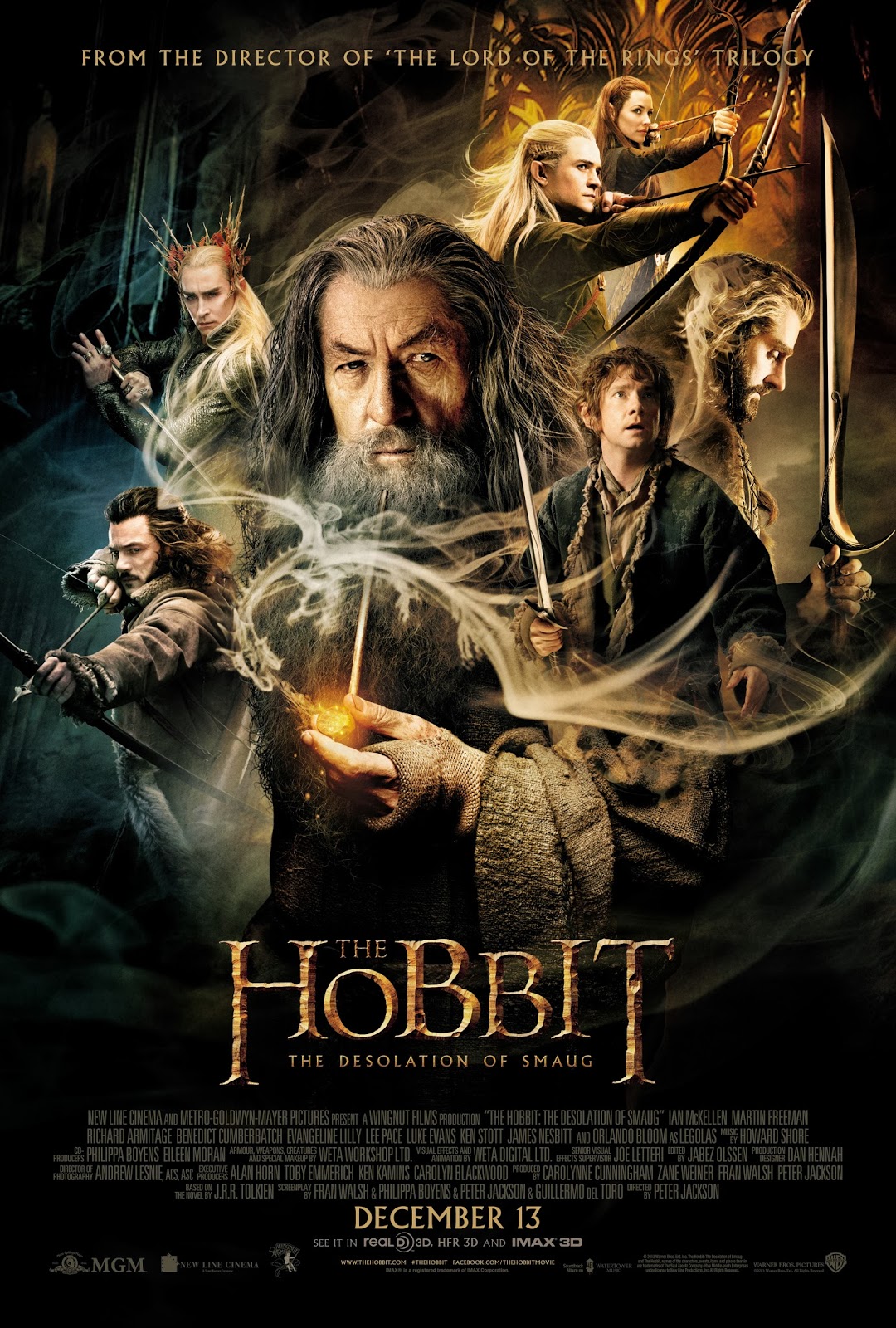
The Hobbit: The Desolation of Smaug
So, this December has brought us the second of Peter Jackson's three films adapting J.R.R. Tolkien's The Hobbit. (See my review of the first one here. I will not be naming returning cast members from the first film.)
How closely these films have stuck to Tolkien's text has been a matter of debate since the first one came out. The Lord of the Rings films had their departures from Tolkien's text, but were largely faithful to the story you could find in the book.
The Hobbit has proved a different matter: The Lord of the Rings is a weightier book than its predecessor, which is often published split into three books, each of which is still longer than The Hobbit. Having once penned a fan script for the classic Tolkien book myself, I'm very aware of how the story in the book can be expanded on.
The big issue facing Jackson was that he'd made The Lord of the Rings before The Hobbit. Of all the characters that would be returning in the prequel trilogy, the most problematic was Gandalf, played by Ian McKellen. Gandalf leaves the company shortly after the events of the first movie, and in the book, he had been set up to be a mysterious character. But now that The Lord of the Rings had portrayed Gandalf as a warm, kind man, having him suddenly turn mysterious and vanish from the second film almost entirely would be confusing to audiences. The answer to how to respect both the character's portrayal and Tolkien's text was to actually show what Gandalf went to do, which Tolkien revealed was actually quite important to setting up the events in The Lord of the Rings. (This expansion had begun in the first film.)
As a result, the second movie has a LOT of material that was not in the book. A good number of it derives from the most controversial change in the first movie: the pursuit of Thorin by his old enemy Azog (who had been dead and gone for years in the book). In this film, Azog is summoned to Dol Guldur to assist the Necromancer (who's revealed to be Sauron, the big baddie of The Lord of the Rings), and he sends his son Bolg to take his place.
In contrast to the first film, the second movie begins with many action-filled pieces. I expect (and hope) that The Desolation of Smaug will be receiving a more substantial extended edition as the beginning of the movie flowed very quickly through the company lodging with Beorn (Mikael Persbrandt) and Mirkwood, cutting out a few points from the book that I would like to see depicted by the cast and Jackson.
The movie begins to slow down as the dwarves are captured by the Wood-elves, including captain Tauriel (Evangeline Lily) and prince Legolas (Orlando Bloom, reprising his role from The Lord of the Rings). When Thorin decides not to accept help from King Thranduil (Lee Pace), the dwarves are kept imprisoned. Kili strikes up a romance with Tauriel (a scene in An Unexpected Journey's extended edition featured him eying elves in Rivendell), probably one of the more non-Tolkien-like expansions of the story for the film. Bilbo soon helps everyone escape in barrels, which are attacked by Bolg and his orcs, leading to another action scene in which Tauriel, Legolas, and surprisingly the heavy dwarf Bombur get to be the big heroes.
The dwarves are smuggled to Lake Town by Bard the Bowman (Luke Evans), who operates a barge in Jackson's film. Lake Town (also known as Esgaroth) is full of people who appear to be peasants ruled by the Master (Stephen Fry), who sees Bard as a troublemaker. However, soon the dwarves head on to the Lonely Mountain at last. In an odd departure from Tolkien's book, four are left behind. (Kili was injured, Fili stays with him, Bofur was drunk, and Oin stays to tend to Kili.) The orcs shortly arrive in Lake Town, but luckily, Legolas and Tauriel have followed.
Gandalf goes to the High Fells and finds that the Ringwraiths have been summoned from their tombs, and then he heads to Dol Guldur to confront the Necromancer, but is captured when he discovers that Sauron is based there.
Finding the secret side door, Bilbo enters Erebor to find the Arkenstone, but instead awakes Smaug (Benedict Cumberbatch through voice and motion capture, who also portrays Sauron). In an extension from the book, the dwarves enter the Mountain to attempt to fight Smaug on their own by tricking him into lighting the forges, but Smaug is still too strong and decides to attack Esgaroth, ending the film.
The film, running at 161 minutes, flowed very quickly and felt like a movie half its length. While some will be critical and cynical about the choice to make the book into three nearly three-hour films, I can appreciate that the expanded time allows us to spend much more time in Middle-Earth at a relaxed pace, even with all the action scenes. The fight with Smaug in Erebor does prove fruitless, but it allows us to take in more of the ancient home of the dwarves that isn't just the dwarves and Bilbo walking around. As mentioned, I hope the extended version expands on Mirkwood, because that felt far too shortened.
While bigger Tolkien nuts can list more reasons why they don't like Kili and Tauriel falling in love, to me, it just seemed like an unnecessary touch. It could have been more effective if all it was was Kili trying to make her let them go. Perhaps something more will be done in the final film. Some fans have also pointed out the compression of the timeline in Jackson's films, but we must remember that this is a visual medium Jackson works in, and it's important to show and not tell.
Leading on from that, it's hard to say whether or not some of these changes and additions are actually going to work out until we see the next film. Unlike other trilogies, Jackson's Middle-Earth trilogies were envisioned as whole pieces. However, I quite enjoyed this one, even with some of its stranger expansions and changes. Smaug is the best movie dragon I've ever seen, and the cast and crew continue to deliver.
It's important to remember that this isn't J.R.R. Tolkien's The Hobbit, but Peter Jackson's. Whatever changes Jackson makes will be wholly his own, while Tolkien's original book will still be around, unaltered for current and future readers to enjoy for what it is.
All the same, I quite enjoyed The Desolation of Smaug and really look forward to December 2014 when the story will wrap up in There and Back Again!
How closely these films have stuck to Tolkien's text has been a matter of debate since the first one came out. The Lord of the Rings films had their departures from Tolkien's text, but were largely faithful to the story you could find in the book.
The Hobbit has proved a different matter: The Lord of the Rings is a weightier book than its predecessor, which is often published split into three books, each of which is still longer than The Hobbit. Having once penned a fan script for the classic Tolkien book myself, I'm very aware of how the story in the book can be expanded on.
The big issue facing Jackson was that he'd made The Lord of the Rings before The Hobbit. Of all the characters that would be returning in the prequel trilogy, the most problematic was Gandalf, played by Ian McKellen. Gandalf leaves the company shortly after the events of the first movie, and in the book, he had been set up to be a mysterious character. But now that The Lord of the Rings had portrayed Gandalf as a warm, kind man, having him suddenly turn mysterious and vanish from the second film almost entirely would be confusing to audiences. The answer to how to respect both the character's portrayal and Tolkien's text was to actually show what Gandalf went to do, which Tolkien revealed was actually quite important to setting up the events in The Lord of the Rings. (This expansion had begun in the first film.)
As a result, the second movie has a LOT of material that was not in the book. A good number of it derives from the most controversial change in the first movie: the pursuit of Thorin by his old enemy Azog (who had been dead and gone for years in the book). In this film, Azog is summoned to Dol Guldur to assist the Necromancer (who's revealed to be Sauron, the big baddie of The Lord of the Rings), and he sends his son Bolg to take his place.
In contrast to the first film, the second movie begins with many action-filled pieces. I expect (and hope) that The Desolation of Smaug will be receiving a more substantial extended edition as the beginning of the movie flowed very quickly through the company lodging with Beorn (Mikael Persbrandt) and Mirkwood, cutting out a few points from the book that I would like to see depicted by the cast and Jackson.
The movie begins to slow down as the dwarves are captured by the Wood-elves, including captain Tauriel (Evangeline Lily) and prince Legolas (Orlando Bloom, reprising his role from The Lord of the Rings). When Thorin decides not to accept help from King Thranduil (Lee Pace), the dwarves are kept imprisoned. Kili strikes up a romance with Tauriel (a scene in An Unexpected Journey's extended edition featured him eying elves in Rivendell), probably one of the more non-Tolkien-like expansions of the story for the film. Bilbo soon helps everyone escape in barrels, which are attacked by Bolg and his orcs, leading to another action scene in which Tauriel, Legolas, and surprisingly the heavy dwarf Bombur get to be the big heroes.
The dwarves are smuggled to Lake Town by Bard the Bowman (Luke Evans), who operates a barge in Jackson's film. Lake Town (also known as Esgaroth) is full of people who appear to be peasants ruled by the Master (Stephen Fry), who sees Bard as a troublemaker. However, soon the dwarves head on to the Lonely Mountain at last. In an odd departure from Tolkien's book, four are left behind. (Kili was injured, Fili stays with him, Bofur was drunk, and Oin stays to tend to Kili.) The orcs shortly arrive in Lake Town, but luckily, Legolas and Tauriel have followed.
Gandalf goes to the High Fells and finds that the Ringwraiths have been summoned from their tombs, and then he heads to Dol Guldur to confront the Necromancer, but is captured when he discovers that Sauron is based there.
Finding the secret side door, Bilbo enters Erebor to find the Arkenstone, but instead awakes Smaug (Benedict Cumberbatch through voice and motion capture, who also portrays Sauron). In an extension from the book, the dwarves enter the Mountain to attempt to fight Smaug on their own by tricking him into lighting the forges, but Smaug is still too strong and decides to attack Esgaroth, ending the film.
The film, running at 161 minutes, flowed very quickly and felt like a movie half its length. While some will be critical and cynical about the choice to make the book into three nearly three-hour films, I can appreciate that the expanded time allows us to spend much more time in Middle-Earth at a relaxed pace, even with all the action scenes. The fight with Smaug in Erebor does prove fruitless, but it allows us to take in more of the ancient home of the dwarves that isn't just the dwarves and Bilbo walking around. As mentioned, I hope the extended version expands on Mirkwood, because that felt far too shortened.
While bigger Tolkien nuts can list more reasons why they don't like Kili and Tauriel falling in love, to me, it just seemed like an unnecessary touch. It could have been more effective if all it was was Kili trying to make her let them go. Perhaps something more will be done in the final film. Some fans have also pointed out the compression of the timeline in Jackson's films, but we must remember that this is a visual medium Jackson works in, and it's important to show and not tell.
Leading on from that, it's hard to say whether or not some of these changes and additions are actually going to work out until we see the next film. Unlike other trilogies, Jackson's Middle-Earth trilogies were envisioned as whole pieces. However, I quite enjoyed this one, even with some of its stranger expansions and changes. Smaug is the best movie dragon I've ever seen, and the cast and crew continue to deliver.
It's important to remember that this isn't J.R.R. Tolkien's The Hobbit, but Peter Jackson's. Whatever changes Jackson makes will be wholly his own, while Tolkien's original book will still be around, unaltered for current and future readers to enjoy for what it is.
All the same, I quite enjoyed The Desolation of Smaug and really look forward to December 2014 when the story will wrap up in There and Back Again!
Saturday, December 14, 2013
The Future of Toyland
In the past thirteen blogs, we've seen many incarnations of the musical Babes in Toyland. My first exposure to the property was a story and songs adaptation of the Disney film that my father had on a vinyl record. Later, I saw some of the film with Drew Barrymore and Keanu Reaves at school. Finally, I got to see the Disney film on VHS, and later, the entire 1986 film (well, the VHS version). A friend loaned us his copy of the Laurel and Hardy film on VHS. Later, we found a picture book adaptation of the story from the library, largely based on the operetta, but the ending was highly altered. Later, I got the Shirley Temple adaptation in the box set I mentioned in that blog.
It was not until researching for these blogs that I found and saw the 1954 and 1997 adaptations, or found the original script for the operetta, or heard quite a bit of the music. The music is really what makes Toyland, so I find myself preferring the adaptations before 1986, which preserved Herbert's melodies.
However, you may have noticed something about these adaptations: they're all from the 20th century. Aside from restagings and new stage adaptations, nothing really major has been done with the property recently.
I mentioned in the blog about the original operetta that the plot didn't age well at all. Some of it (such as Alan's suicide option) is actually pretty bleak. The response to this has consistently been to create a wholly new story using a little of the original.
However, perhaps a new version could offer some revision that could bring the story to the 21st century without losing so much of the original. One major storytelling device: early on, establish where Toyland is in relation to the land where the story begins. Unlike the Disney adaptation, in the operetta, its location seems to be known to many characters.
Another is to flesh out the characters: why does Barnaby want to marry Mary? Why do Alan and Jane seem unaware of their uncle's wicked nature? How has the Toymaker gone wrong? If he dies in this version, does Grumio take over from him? Does Grumio have plans on what to do with the toy factory?
Another must is to not cut out the music. As I say, the music is the key piece of Toyland, but most modern musicals use music to advance the story or define the characters. Perhaps a skilled lyricist could help bring the songs up to date while not wholly rewriting them or tossing them out.
So, where will Babes in Toyland develop next? A major stage revival? A new film? A graphic novel? Who knows? But I certainly hope some of these suggestions I've made will be considered.
Here is my best to not really the best ranking of these adaptations of Babes in Toyland:
Sam Milazzo.
It was not until researching for these blogs that I found and saw the 1954 and 1997 adaptations, or found the original script for the operetta, or heard quite a bit of the music. The music is really what makes Toyland, so I find myself preferring the adaptations before 1986, which preserved Herbert's melodies.
However, you may have noticed something about these adaptations: they're all from the 20th century. Aside from restagings and new stage adaptations, nothing really major has been done with the property recently.
I mentioned in the blog about the original operetta that the plot didn't age well at all. Some of it (such as Alan's suicide option) is actually pretty bleak. The response to this has consistently been to create a wholly new story using a little of the original.
However, perhaps a new version could offer some revision that could bring the story to the 21st century without losing so much of the original. One major storytelling device: early on, establish where Toyland is in relation to the land where the story begins. Unlike the Disney adaptation, in the operetta, its location seems to be known to many characters.
Another is to flesh out the characters: why does Barnaby want to marry Mary? Why do Alan and Jane seem unaware of their uncle's wicked nature? How has the Toymaker gone wrong? If he dies in this version, does Grumio take over from him? Does Grumio have plans on what to do with the toy factory?
Another must is to not cut out the music. As I say, the music is the key piece of Toyland, but most modern musicals use music to advance the story or define the characters. Perhaps a skilled lyricist could help bring the songs up to date while not wholly rewriting them or tossing them out.
So, where will Babes in Toyland develop next? A major stage revival? A new film? A graphic novel? Who knows? But I certainly hope some of these suggestions I've made will be considered.
Here is my best to not really the best ranking of these adaptations of Babes in Toyland:
- The Laurel and Hardy adaptation, also known as The March of the Wooden Soldiers. Surprisingly, although this uses little of the original plot, it retains quite a lot of the music of the operetta and also still renders a musical comedy delight.
- Shirley Temple's TV version, for retaining a surprising amount of the original operetta's plot and still being a delightful musical, despite running under an hour.
- The Disney film adaptation, for attempting to bring the Herbert melodies to a new generation, and having a stunning cast, despite the plot falling apart halfway through the film.
- Max Liebman's TV versions, for bringing the wonderful music to homes through television broadcast, although it has the weakest plot of all of these adaptations.
- The 1997 animated film, for bringing the property to a new medium and having a plot that works. However, the dropping of most of the plot of the operetta and the music.
- The 1986 TV version, for replacing most of Herbert's music with forgettable songs and inserting a plot that promises to be more compelling than it actually was.
Sam Milazzo.
Friday, December 13, 2013
An Animated Toyland
As we've been going through these film adaptations of Babes in Toyland, you may have noticed that all of them have something in common: they've all been live action. Well, at the end of our series, we come to the first fully animated adaptation of the operetta and also the last (so far) film adaptation.
This version of Toyland was released direct to video in 1997, and like the previous adaptation from 1986, it drops all but two pieces of music from Victor Herbert's score: "Toyland" (with a rewritten chorus) and "March of the Toys."
The movie opens with Humpty Dumpty (Charles Nelson Reilly) bathing on the moon, singing "Toyland," then falling to a train heading to Toyland, where we meet Jack (Joseph Ashton) and Jill (Lacey Chabert), two children (implied to be orphans) who are going to Toyland to live with their uncle, Barnaby Crookedman (Christopher Plummer). On the train, they meet Tom Piper (Raphael Sbarge), who manages the Toyland Factory. Leaving the train, they meet Mary Lamb (Cathy Cavadini), who is the owner of the factory.
After a romp around Toyland (featuring another round of "Toyland"), Humpty Dumpty drops Jack and Jill off at Barnaby's, who keeps the children in the attic, grudgingly. Meanwhile, Tom and Mary scramble on how to fill a large order from Santa Claus in time for Christmas Eve, three days away. This leads to the first original song, "Dream," in which Jack and Jill express their wish for a kind home, and Tom and Mary express romantic interest in each other.
Barnaby detests toys, so he plans to shut down the toy factory by either buying it (he is refused) or trying to kill Tom (it failed). So, he decides to turn to sabotage. Jack and Jill manage to sneak out to see the toy factory, and of course, there is "The Factory Song." Barnaby catches Jack and Jill there, throws them back in the attic, threatening to send them to the Goblin Forest if he catches them at the Factory again. There is then another song as Barnaby sings about himself, assisted by a candelabra in the song "A Crooked Man."
Barnaby hires pirates Gonzargo (James Belushi) and Rodrigo (Bronson Pinchot) to sabotage the factory, but Jack and Jill manage to help stop their plot. Jack and Jill chase Gonzargo and Rodrigo, who eventually reveal what happened to Barnaby, who has the children taken to the Goblin Forest. Dropping the children off, the two pirates sing "The Worst Is Yet to Come" as the Goblins arrive. The Goblin King (Lindsay Schnebly) is about to eat the four newcomers to the Forest, when Mary and Tom (being warned by an observant Humpty Dumpty) arrive and fight the Goblins off with flashlights.
Barnaby takes the keys to the Factory away from Humpty Dumpty, knocking him off of a wall to do so, but Mary and Tom arrive in time to stop him from entering. Resuming making toys, Tom and Mary sing "It's You," confessing their love for each other. Barnaby, meanwhile, brings the Goblins to Toyland, where they break into the factory and set it on fire. It almost looks like they've lost until Tom brings the giant Toy Soldiers to life. The Soldiers drive the Goblins back and stop the damage they're causing in Toyland.
The Goblin King is about to eat Barnaby, when several lights are focused on him, reducing him to a bubbling puddle. The other goblins, realizing that Barnaby was never their friend, surround him and chase him out of Toyland. Jack, Jill, Tom and Mary find the broken Humpty Dumpty, and Tom repairs him with a stainless steel shell.
Christmas Eve arrives and Santa picks up the toys from Toyland (including shrinking the Toy Soldiers). He turns over Scat, Barnaby's cat, to Jill before taking off to make his deliveries. It's implied that Jack and Jill will be cared for by Tom and Mary, who will likely marry eventually. The moon swoops down and picks up Humpty Dumpty, who flies back into the sky with yet another round of "Toyland."
Although there's little of the original operetta here (the only comparable plot point: Barnaby sending Jack and Jill to the Goblin Forest is akin to how he originally has Alan and Jane "drowned" at sea), one must admit that at least the plot hangs together well. I did, however, wish that the songs were better integrated into the story. Too often it felt like stopping the story for a song sequence. Quite possibly, though, perhaps the Goblins themselves were inspired by the Boogeymen from the Laurel and Hardy film of 1934.
Currently, this Babes in Toyland is available on VHS and DVD, as well as being available on Netflix (in the US).
Oz connections? Jim Belushi will be voicing the Cowardly Lion in next year's The Legends of Oz: Dorothy Returns, and Bronson Pinchot is an Oz fan.
This version of Toyland was released direct to video in 1997, and like the previous adaptation from 1986, it drops all but two pieces of music from Victor Herbert's score: "Toyland" (with a rewritten chorus) and "March of the Toys."
The movie opens with Humpty Dumpty (Charles Nelson Reilly) bathing on the moon, singing "Toyland," then falling to a train heading to Toyland, where we meet Jack (Joseph Ashton) and Jill (Lacey Chabert), two children (implied to be orphans) who are going to Toyland to live with their uncle, Barnaby Crookedman (Christopher Plummer). On the train, they meet Tom Piper (Raphael Sbarge), who manages the Toyland Factory. Leaving the train, they meet Mary Lamb (Cathy Cavadini), who is the owner of the factory.
After a romp around Toyland (featuring another round of "Toyland"), Humpty Dumpty drops Jack and Jill off at Barnaby's, who keeps the children in the attic, grudgingly. Meanwhile, Tom and Mary scramble on how to fill a large order from Santa Claus in time for Christmas Eve, three days away. This leads to the first original song, "Dream," in which Jack and Jill express their wish for a kind home, and Tom and Mary express romantic interest in each other.
Barnaby detests toys, so he plans to shut down the toy factory by either buying it (he is refused) or trying to kill Tom (it failed). So, he decides to turn to sabotage. Jack and Jill manage to sneak out to see the toy factory, and of course, there is "The Factory Song." Barnaby catches Jack and Jill there, throws them back in the attic, threatening to send them to the Goblin Forest if he catches them at the Factory again. There is then another song as Barnaby sings about himself, assisted by a candelabra in the song "A Crooked Man."
Barnaby hires pirates Gonzargo (James Belushi) and Rodrigo (Bronson Pinchot) to sabotage the factory, but Jack and Jill manage to help stop their plot. Jack and Jill chase Gonzargo and Rodrigo, who eventually reveal what happened to Barnaby, who has the children taken to the Goblin Forest. Dropping the children off, the two pirates sing "The Worst Is Yet to Come" as the Goblins arrive. The Goblin King (Lindsay Schnebly) is about to eat the four newcomers to the Forest, when Mary and Tom (being warned by an observant Humpty Dumpty) arrive and fight the Goblins off with flashlights.
Barnaby takes the keys to the Factory away from Humpty Dumpty, knocking him off of a wall to do so, but Mary and Tom arrive in time to stop him from entering. Resuming making toys, Tom and Mary sing "It's You," confessing their love for each other. Barnaby, meanwhile, brings the Goblins to Toyland, where they break into the factory and set it on fire. It almost looks like they've lost until Tom brings the giant Toy Soldiers to life. The Soldiers drive the Goblins back and stop the damage they're causing in Toyland.
The Goblin King is about to eat Barnaby, when several lights are focused on him, reducing him to a bubbling puddle. The other goblins, realizing that Barnaby was never their friend, surround him and chase him out of Toyland. Jack, Jill, Tom and Mary find the broken Humpty Dumpty, and Tom repairs him with a stainless steel shell.
Christmas Eve arrives and Santa picks up the toys from Toyland (including shrinking the Toy Soldiers). He turns over Scat, Barnaby's cat, to Jill before taking off to make his deliveries. It's implied that Jack and Jill will be cared for by Tom and Mary, who will likely marry eventually. The moon swoops down and picks up Humpty Dumpty, who flies back into the sky with yet another round of "Toyland."
Although there's little of the original operetta here (the only comparable plot point: Barnaby sending Jack and Jill to the Goblin Forest is akin to how he originally has Alan and Jane "drowned" at sea), one must admit that at least the plot hangs together well. I did, however, wish that the songs were better integrated into the story. Too often it felt like stopping the story for a song sequence. Quite possibly, though, perhaps the Goblins themselves were inspired by the Boogeymen from the Laurel and Hardy film of 1934.
Currently, this Babes in Toyland is available on VHS and DVD, as well as being available on Netflix (in the US).
Oz connections? Jim Belushi will be voicing the Cowardly Lion in next year's The Legends of Oz: Dorothy Returns, and Bronson Pinchot is an Oz fan.
Thursday, December 12, 2013
Leo the Lion's Babes in Toyland
As the final entry to the vintage Toyland audio treasures, here is, from 1963, a very brief adaptation of Babes in Toyland, running at just under 14 minutes. It was released to fill up the rest of the space on an album that featured an audio adaptation of the MGM film version of The Wizard of Oz. I wrote about the album on my Oz blog, summarizing this adaptation. The publisher was Leo the Lion records, which was, of course, a subsidiary of MGM.
Wednesday, December 11, 2013
Keanu and Drew in Toyland
So, the Disney and Laurel and Hardy versions of Babes in Toyland became popular Christmas time TV fodder, many children being first introduced to the music through these versions being aired on TV. So in 1986, a new made for TV version came out, featuring some rising stars: Drew Barrymore and Keanu Reeves.
This version decided to dispense of most of Victor Herbert's music, retaining only a chorus of "Toyland" (with rewritten lyrics) and using "March of the Toys." At least eight songs were created for the movie by Leslie Bricusse, who most of us know best (despite his host of other credits) as working with Anthony Newley on the score and songs for Willy Wonka and the Chocolate Factory.
The TV movie debuted with a cut that ran for two hours and twenty minutes. However, this cut is unavailable today. When it was released overseas as a theatrical film, it was trimmed down to 94 minutes, with three of the songs getting cut. This version was released to home video (first VHS, now available digitally through Amazon Instant Video) and is now aired when the film is rerun on television. These three deleted songs that I know exist have been uploaded to YouTube.
The story opens in a wintry Cincinnati, Ohio as young Lisa Piper (Drew Barrymore) sees her sister Mary (Jill Schoelen) off to work. Lisa gets a phone call from her mother (Eileen Brennan) that she's having a little bit of trouble getting home. A blizzard starts picking up and the phone goes out after a power line is broken (logic flaw #1, why did the fallen power line only cut out the phone and not the power?). Lisa runs to her sister's job at a local store, where she finds her sister being harassed by her manager, Barney (Richard Mulligan). Mary quits, and after Lisa uses the intercom to warn customers of the blizzard. Mary gives Lisa her present: a sled. Mary's coworkers Jack (Keanu Reeves) and George (Googy Gress) quit as well, and Jack offers them all a lift home.
As they drive home (logic flaw #2, considering Lisa was able to run over to her sister's job, why is it taking so long for them to get home?), they sing the first song, probably one of the worst in the movie: "C-I-N-C-I-N-N-A-T-I." During this song, Jack dodges obstacles on the road, and at one bad turn, Lisa slides out on her sled and hits a tree.
Lisa then finds herself floating to Toyland on her sled and landing in a giant cake. (It is during this scene that we hear a voice sing "Toyland, Toyland, every child dreams of Toyland.") She meets Georgie Porgie (Googy Gress, yes, he plays two characters), who tells her that his friend Mary Contrary (Jill Schoelen) is getting married to Barnaby Barnacle (Richard Mulligan, spotting a trend?), despite her being in love with Jack-Be-Nimble (Keanu Reeves), who happens to be Barnaby's nephew.
Barnaby lives in a giant bowling ball with his two assistants Zack and Mack and an evil creature called Troller. Georgie says that he sometimes rolls his ball into the street and knocks people over when he's upset, though this doesn't happen in this cut.
At the wedding (accompanied by the song "May We Wish You The Happiest Marriage"), Lisa ends the ceremony by protesting that Mary doesn't love Barnaby. Barnaby threatens Lisa, but the rest of Toyland hails her as a hero in another song sequence. The only other person in Toyland who disagrees with Lisa's action is Widow Hubbard (Eileen Brennan), who was hoping for some financial security from Mary's marriage.
Meantime, Barnaby tricks everyone in the Toyland cookie factory (which is key to Toyland's economy instead of toys for some reason) while he and Zack and Mack dump the entire stock of finished cookies down a trap door, presumably to feed Barnaby's troll army that he wants to use to take over Toyland with. With only an accusation by Barnaby and Jack admitting that he's the security guard of the cookie factory, Justice Grimm (Walter Buschhoff) has Tom imprisoned, but almost too easily, Mary, Lisa and Georgie break Jack out of jail. (Lisa distracts Justice Grimm while Georgie steals the keys.)
They go to the Toymaster of Toyland (Pat Morita, best known as Mr. Miyagi from The Karate Kid), who shows them some giant toy soldiers locked away in cabinets and a flask containing the evil of the world that he's been collecting. He wants to collect Barnaby's, believing that there may yet be good in him. However, Barnaby has seen this through Troller's eye.
Jack heads back to the cookie factory to look for clues as to the real reason for the cookies' disappearance, but when he finds the trap door, Zack and Mack send him down it. He winds up in Barnaby's jail, and the villain sings a song called "Monsterpiece," where he reveals he plans to take over Toyland, and "tomorrow, the world!" Shortly, Mary is also captured when she goes to search Barnaby's house.
Going to the Toymaster, Lisa and Georgie appeal for help, but Barnaby, Troller, Zack and Mack arrive and tie the three up in chairs and Barnaby steals the flask of evil. Troller is left to eat the prisoners, but Lisa gets out of her ropes and Troller is blinded and put in a chest. Lisa and Georgie then go to the Forest of Night, where they are also sent to Barnaby's prison.
Barnaby opens the flask to turn Jack, Mary, Georgie and Lisa into trolls, but Lisa finds herself immune, presuming that she's from Cincinnati. Reprising "C-I-N-C-I-N-N-A-T-I," she manages to keep everyone else from turning evil. They return to the Toymaster, who says that the toy soldiers can't defend Toyland because someone doesn't believe in toys, someone who "was never a child." They realize this is Lisa, who has been trying to do "grown up" work and continually claiming that she isn't a child. The Toymaster sings "Through the Eyes of a Child," encouraging Lisa to embrace her childhood. She lets go of her inhibitions, and opens the doors for the toy soldiers just as Barnaby's trolls invade Toyland.
The citizens of Toyland and the soldiers manage to force the trolls and Zack and Mack into the Forest of Night. Barnaby tries to capture Lisa, but is spotted by Mary, and Jack fights Barnaby. The Toymaster banishes Barnaby into the Forest.
With a triumphant reprise of "May We Wish You The Happiest Marriage," Jack and Mary marry, and Lisa gets a ride home from the Toymaster, who turns out to also be Santa Claus, driving his sleigh of wooden reindeer.
Lisa then awakens at home, awakening from her dream, being tended to by her mother, with Mary, Jack and George watching as well. (Logic flaw, why didn't they take her to the hospital?) She tells them about Toyland and how she learned to believe in her childhood. As she hugs her mother, she spots a toy soldier under the tree. It salutes her.
Given how odd the movie was, I find it difficult to believe that it was actually 50 minutes longer. But the three deleted songs, as I mentioned, are on YouTube, proving that cut footage does exist. (The three cut songs—"Jailbreak," a love song between Jack and Mary in prison, and "My Two Worlds"—are very weak and the film is better without them.) Perhaps some logic flaws were remedied in the extra footage, but fifty additional minutes seems as if it would have been too long no matter the case. (This means that the movie filled a three-hour time slot on television. Children would probably be at or past their bedtime when it finished.)
The remaining songs are all right. "Through the Eyes of a Child" is likely the best of the bunch. "May We Wish You The Happiest Marriage" is a rather nice one, and it seems some people actually like "Monsterpiece," though it seems more like Barnaby is just saying the lyrics as the music plays. "C-I-N-C-I-N-N-A-T-I" gets the worst song here as it is infuriatingly catchy. The celebration song after Lisa stops the wedding is just bland.
The plot is, admittedly, better constructed than some other versions of Toyland, though it suffers from several storytelling flaws. The Oz connection arises here as the dream motif from MGM's The Wizard of Oz is clearly borrowed here as the principal people in Toyland are seemingly suggested by the people Lisa knows and has met in Cincinnati, with the exception of the Toymaster. This parallels how Glinda in The Wizard of Oz has no Kansas counterpart. That said, it just doesn't really feel compelling. We rarely get a sense of danger for Toyland or our heroes. (When Lisa does seem to be in the most danger, she's suddenly immune to it.)
The plot has little to do with the original operetta. Barnaby wants to marry Mary, and surprise, of all things, the Toymaker's flask is brought over, though the use is very different. (In the operetta, the flask contained evil spirits that the Toymaker used to bring the toys to life.) That's about all the similarities, though. Instead, it's supposed to be about a girl who felt she needed to grow up before she really did and almost missed out on embracing her childhood. The issue is, this is barely established at the beginning. Yes, we see Lisa acting amazingly mature, but we never get the idea that she's doing this at the cost of her childhood.
It does surprise me, however, that although this version was largely filmed on location outdoors, the Laurel and Hardy film of 1934 was far more successful at selling a fantasy world even though it was filmed on a soundstage. Toyland in this film just looks so ordinary.
So, for retaining only a little of Herbert's music and creating a plot that ultimately didn't work out, this is a Toyland you could pass on, if you wish.
This version decided to dispense of most of Victor Herbert's music, retaining only a chorus of "Toyland" (with rewritten lyrics) and using "March of the Toys." At least eight songs were created for the movie by Leslie Bricusse, who most of us know best (despite his host of other credits) as working with Anthony Newley on the score and songs for Willy Wonka and the Chocolate Factory.
The TV movie debuted with a cut that ran for two hours and twenty minutes. However, this cut is unavailable today. When it was released overseas as a theatrical film, it was trimmed down to 94 minutes, with three of the songs getting cut. This version was released to home video (first VHS, now available digitally through Amazon Instant Video) and is now aired when the film is rerun on television. These three deleted songs that I know exist have been uploaded to YouTube.
The story opens in a wintry Cincinnati, Ohio as young Lisa Piper (Drew Barrymore) sees her sister Mary (Jill Schoelen) off to work. Lisa gets a phone call from her mother (Eileen Brennan) that she's having a little bit of trouble getting home. A blizzard starts picking up and the phone goes out after a power line is broken (logic flaw #1, why did the fallen power line only cut out the phone and not the power?). Lisa runs to her sister's job at a local store, where she finds her sister being harassed by her manager, Barney (Richard Mulligan). Mary quits, and after Lisa uses the intercom to warn customers of the blizzard. Mary gives Lisa her present: a sled. Mary's coworkers Jack (Keanu Reeves) and George (Googy Gress) quit as well, and Jack offers them all a lift home.
As they drive home (logic flaw #2, considering Lisa was able to run over to her sister's job, why is it taking so long for them to get home?), they sing the first song, probably one of the worst in the movie: "C-I-N-C-I-N-N-A-T-I." During this song, Jack dodges obstacles on the road, and at one bad turn, Lisa slides out on her sled and hits a tree.
Lisa then finds herself floating to Toyland on her sled and landing in a giant cake. (It is during this scene that we hear a voice sing "Toyland, Toyland, every child dreams of Toyland.") She meets Georgie Porgie (Googy Gress, yes, he plays two characters), who tells her that his friend Mary Contrary (Jill Schoelen) is getting married to Barnaby Barnacle (Richard Mulligan, spotting a trend?), despite her being in love with Jack-Be-Nimble (Keanu Reeves), who happens to be Barnaby's nephew.
Barnaby lives in a giant bowling ball with his two assistants Zack and Mack and an evil creature called Troller. Georgie says that he sometimes rolls his ball into the street and knocks people over when he's upset, though this doesn't happen in this cut.
At the wedding (accompanied by the song "May We Wish You The Happiest Marriage"), Lisa ends the ceremony by protesting that Mary doesn't love Barnaby. Barnaby threatens Lisa, but the rest of Toyland hails her as a hero in another song sequence. The only other person in Toyland who disagrees with Lisa's action is Widow Hubbard (Eileen Brennan), who was hoping for some financial security from Mary's marriage.
Meantime, Barnaby tricks everyone in the Toyland cookie factory (which is key to Toyland's economy instead of toys for some reason) while he and Zack and Mack dump the entire stock of finished cookies down a trap door, presumably to feed Barnaby's troll army that he wants to use to take over Toyland with. With only an accusation by Barnaby and Jack admitting that he's the security guard of the cookie factory, Justice Grimm (Walter Buschhoff) has Tom imprisoned, but almost too easily, Mary, Lisa and Georgie break Jack out of jail. (Lisa distracts Justice Grimm while Georgie steals the keys.)
They go to the Toymaster of Toyland (Pat Morita, best known as Mr. Miyagi from The Karate Kid), who shows them some giant toy soldiers locked away in cabinets and a flask containing the evil of the world that he's been collecting. He wants to collect Barnaby's, believing that there may yet be good in him. However, Barnaby has seen this through Troller's eye.
Jack heads back to the cookie factory to look for clues as to the real reason for the cookies' disappearance, but when he finds the trap door, Zack and Mack send him down it. He winds up in Barnaby's jail, and the villain sings a song called "Monsterpiece," where he reveals he plans to take over Toyland, and "tomorrow, the world!" Shortly, Mary is also captured when she goes to search Barnaby's house.
Going to the Toymaster, Lisa and Georgie appeal for help, but Barnaby, Troller, Zack and Mack arrive and tie the three up in chairs and Barnaby steals the flask of evil. Troller is left to eat the prisoners, but Lisa gets out of her ropes and Troller is blinded and put in a chest. Lisa and Georgie then go to the Forest of Night, where they are also sent to Barnaby's prison.
Barnaby opens the flask to turn Jack, Mary, Georgie and Lisa into trolls, but Lisa finds herself immune, presuming that she's from Cincinnati. Reprising "C-I-N-C-I-N-N-A-T-I," she manages to keep everyone else from turning evil. They return to the Toymaster, who says that the toy soldiers can't defend Toyland because someone doesn't believe in toys, someone who "was never a child." They realize this is Lisa, who has been trying to do "grown up" work and continually claiming that she isn't a child. The Toymaster sings "Through the Eyes of a Child," encouraging Lisa to embrace her childhood. She lets go of her inhibitions, and opens the doors for the toy soldiers just as Barnaby's trolls invade Toyland.
The citizens of Toyland and the soldiers manage to force the trolls and Zack and Mack into the Forest of Night. Barnaby tries to capture Lisa, but is spotted by Mary, and Jack fights Barnaby. The Toymaster banishes Barnaby into the Forest.
With a triumphant reprise of "May We Wish You The Happiest Marriage," Jack and Mary marry, and Lisa gets a ride home from the Toymaster, who turns out to also be Santa Claus, driving his sleigh of wooden reindeer.
Lisa then awakens at home, awakening from her dream, being tended to by her mother, with Mary, Jack and George watching as well. (Logic flaw, why didn't they take her to the hospital?) She tells them about Toyland and how she learned to believe in her childhood. As she hugs her mother, she spots a toy soldier under the tree. It salutes her.
Given how odd the movie was, I find it difficult to believe that it was actually 50 minutes longer. But the three deleted songs, as I mentioned, are on YouTube, proving that cut footage does exist. (The three cut songs—"Jailbreak," a love song between Jack and Mary in prison, and "My Two Worlds"—are very weak and the film is better without them.) Perhaps some logic flaws were remedied in the extra footage, but fifty additional minutes seems as if it would have been too long no matter the case. (This means that the movie filled a three-hour time slot on television. Children would probably be at or past their bedtime when it finished.)
The remaining songs are all right. "Through the Eyes of a Child" is likely the best of the bunch. "May We Wish You The Happiest Marriage" is a rather nice one, and it seems some people actually like "Monsterpiece," though it seems more like Barnaby is just saying the lyrics as the music plays. "C-I-N-C-I-N-N-A-T-I" gets the worst song here as it is infuriatingly catchy. The celebration song after Lisa stops the wedding is just bland.
The plot is, admittedly, better constructed than some other versions of Toyland, though it suffers from several storytelling flaws. The Oz connection arises here as the dream motif from MGM's The Wizard of Oz is clearly borrowed here as the principal people in Toyland are seemingly suggested by the people Lisa knows and has met in Cincinnati, with the exception of the Toymaster. This parallels how Glinda in The Wizard of Oz has no Kansas counterpart. That said, it just doesn't really feel compelling. We rarely get a sense of danger for Toyland or our heroes. (When Lisa does seem to be in the most danger, she's suddenly immune to it.)
The plot has little to do with the original operetta. Barnaby wants to marry Mary, and surprise, of all things, the Toymaker's flask is brought over, though the use is very different. (In the operetta, the flask contained evil spirits that the Toymaker used to bring the toys to life.) That's about all the similarities, though. Instead, it's supposed to be about a girl who felt she needed to grow up before she really did and almost missed out on embracing her childhood. The issue is, this is barely established at the beginning. Yes, we see Lisa acting amazingly mature, but we never get the idea that she's doing this at the cost of her childhood.
It does surprise me, however, that although this version was largely filmed on location outdoors, the Laurel and Hardy film of 1934 was far more successful at selling a fantasy world even though it was filmed on a soundstage. Toyland in this film just looks so ordinary.
So, for retaining only a little of Herbert's music and creating a plot that ultimately didn't work out, this is a Toyland you could pass on, if you wish.
These pictures were acquired from a TV broadcast that cropped the image to a widescreen picture.
Subscribe to:
Posts (Atom)